

You already know the smell. Percolator coffee, a cast-iron skillet warming on the burner, that particular cabinet that always stuck when you tried to open it.
Most of what lived in grandma’s kitchen felt like clutter. Chipped bowls. Old glass. A silverware set nobody used except on holidays.
Some of it was worth pennies. Some of it is worth thousands.
The trick is knowing which is which — and the difference often comes down to a color, a mark on the base, or a lid that survived sixty years without cracking.
Before you box the estate up for the thrift store, look closer. Here are 25 kitchen items from grandma’s house that collectors are paying real money for right now.
1. Patterned Vintage Pyrex (the rare promotional colors)
Start here, because this is where the shocking numbers live.
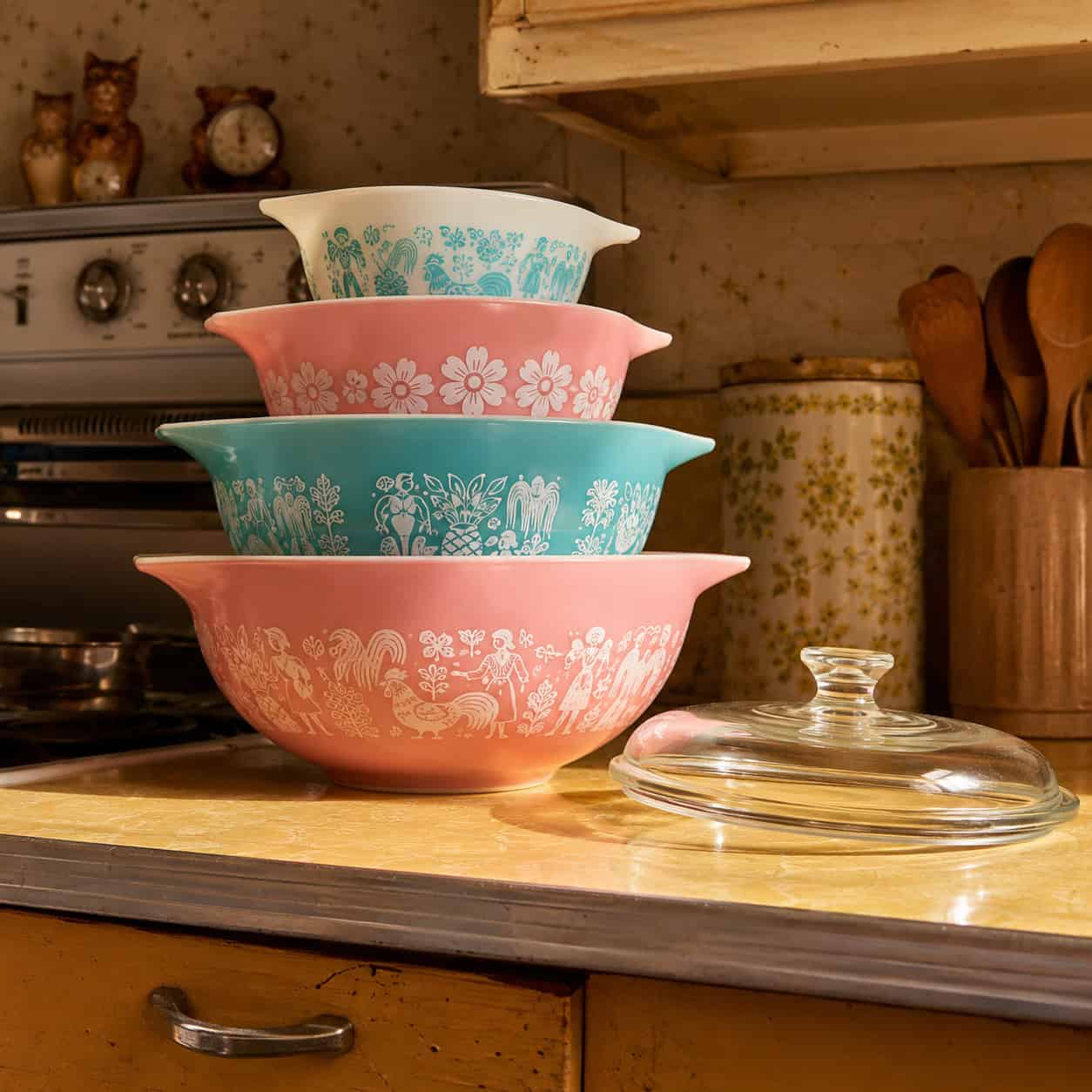
Everyday Pyrex is common and cheap. The rare stuff is a different animal entirely. A “Lucky in Love” promotional dish from 1959 — white with green clovers and pink hearts — has sold for more than $4,000. A Golden Sunflower set topped $5,000 on eBay.
What makes a piece valuable is scarcity and condition. Turquoise and pink patterns, test patterns that never went into full production, and promotional runs made for a single holiday season are the trophies.
Two things drive the price. Original lids double a set’s value. And the painted pattern has to be bright — no fading, no dishwasher-dulled spots, no scratches where a metal spoon rode against the enamel.
Hold a piece to the light. If the color is deep and even and the lid is still with it, don’t donate it. The Estate Sale Blog keeps a running guide to which patterns command the most.
2. CorningWare Blue Cornflower Casseroles
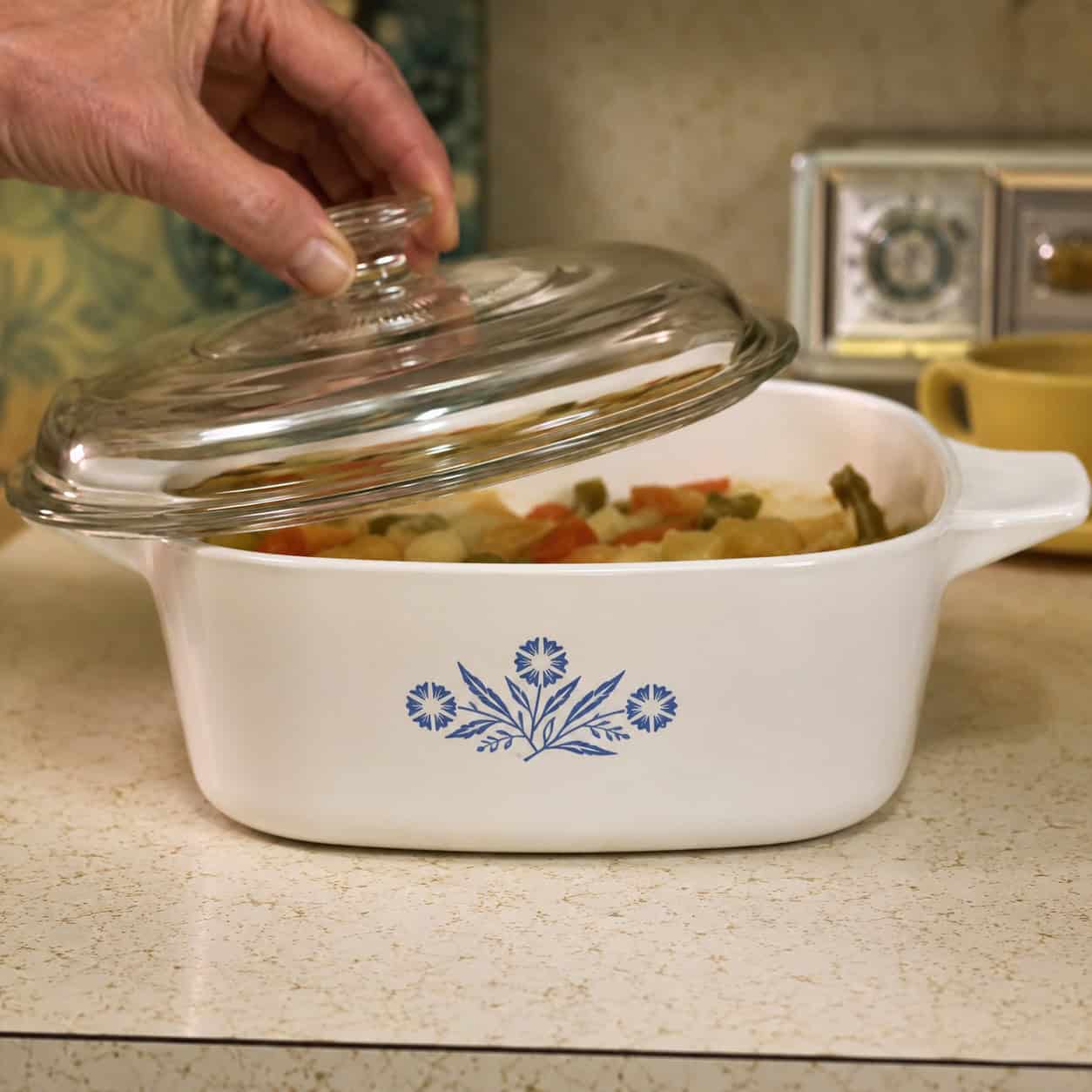
That white dish with the little blue flower sat in nearly every mid-century kitchen. You’d know it blindfolded.
Introduced in 1958, Blue Cornflower CorningWare went into ovens, freezers, and dishwashers for decades. Most pieces are still worth modest money — but the early ones with their matching glass lids can climb into the thousands.
Condition and completeness are everything. A casserole with its original lid, no crazing, no stovetop scorch marks, is what buyers chase.
Antiques expert Dr. Lori has flagged 1970s patterns like La Marjolaine as a current collector craze. The flowers you barely noticed as a kid are the ones people hunt now.
Check the bottom for the pattern name and pull out the lids. A bare dish and a boxed lid can quietly reunite for a much bigger sale.
3. Cast-Iron Skillets by Griswold and Wagner
Grandma’s bacon skillet is genuinely trendy.
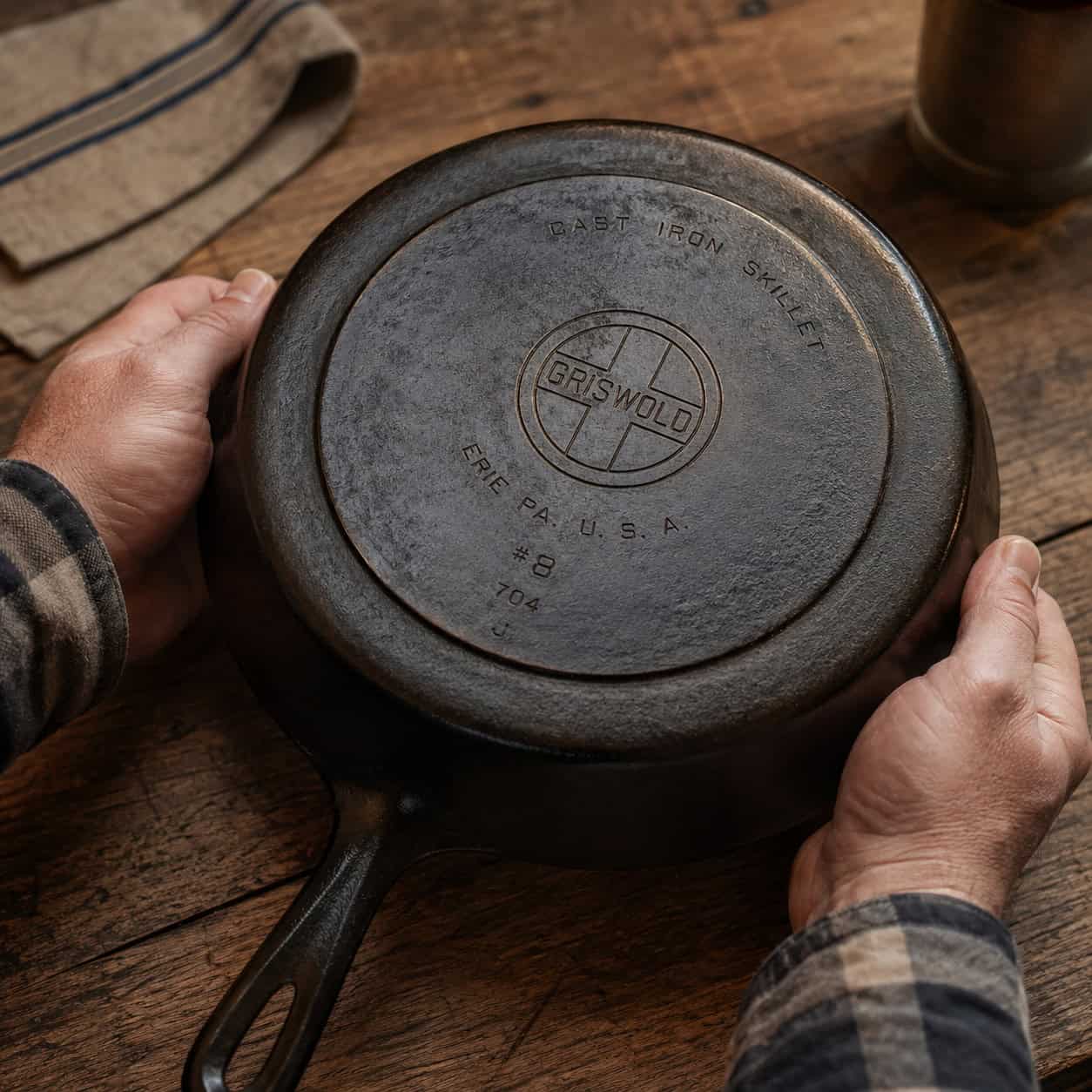
Two names matter above the rest: Griswold and Wagner. Both made smooth, machine-polished cooking surfaces that modern factory pans can’t match, and both stamped clear maker’s marks you can read with the pan in your hand.
Flip it over. Griswold pieces often read “Erie, PA” around a cross-and-circle logo. Wagner marked its wares plainly too. A legible mark plus a glassy-smooth interior is the combination collectors want.
Prices run $100 to several hundred for good examples. Rare sizes and standout pieces have listed in the thousands.
Rust doesn’t scare buyers — it seasons off. A crack or a warped, wobbling base does. Set it on a flat counter and check that it sits dead still.
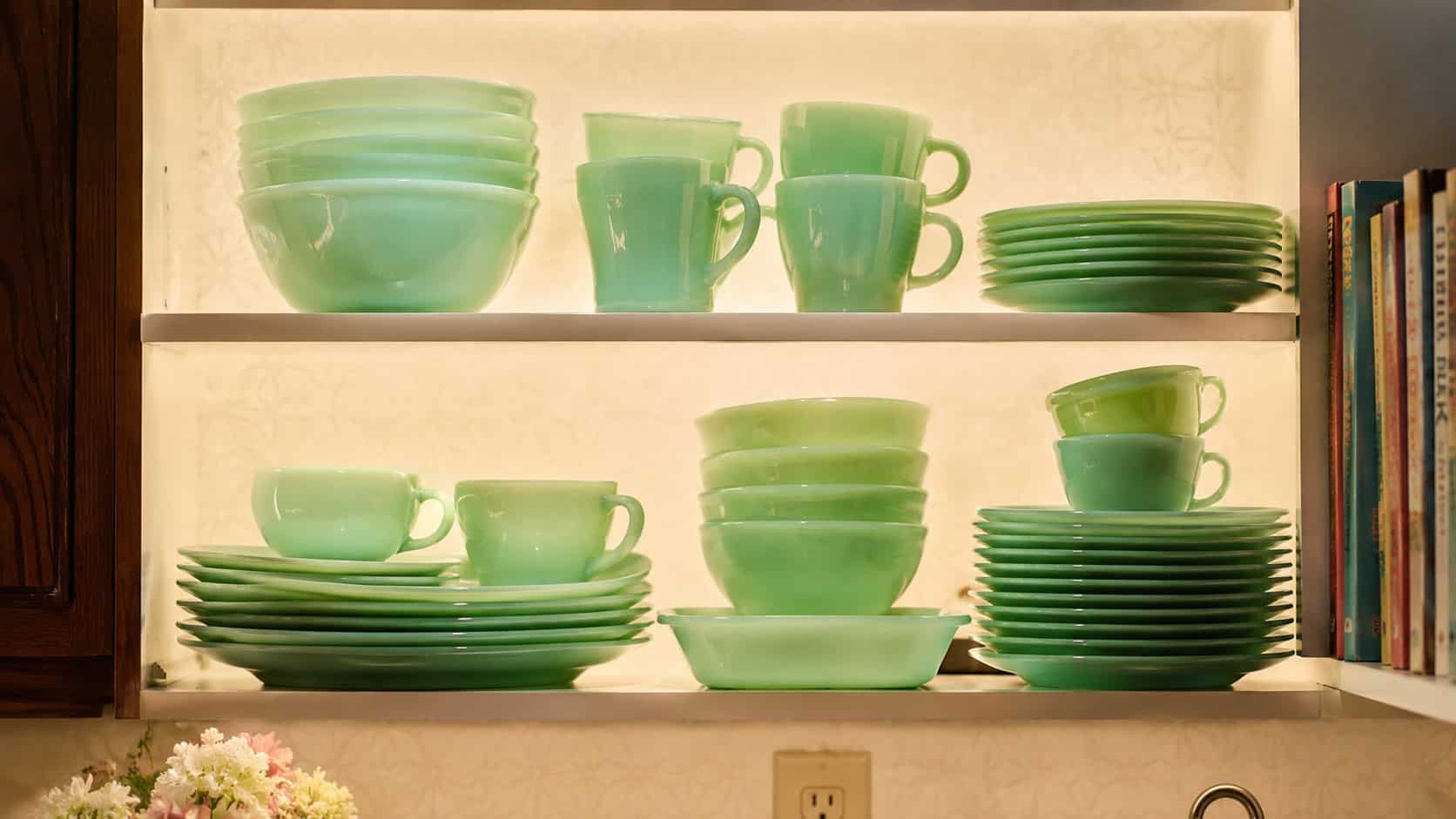
4. Fire-King Jadeite (the milky-green dishes)
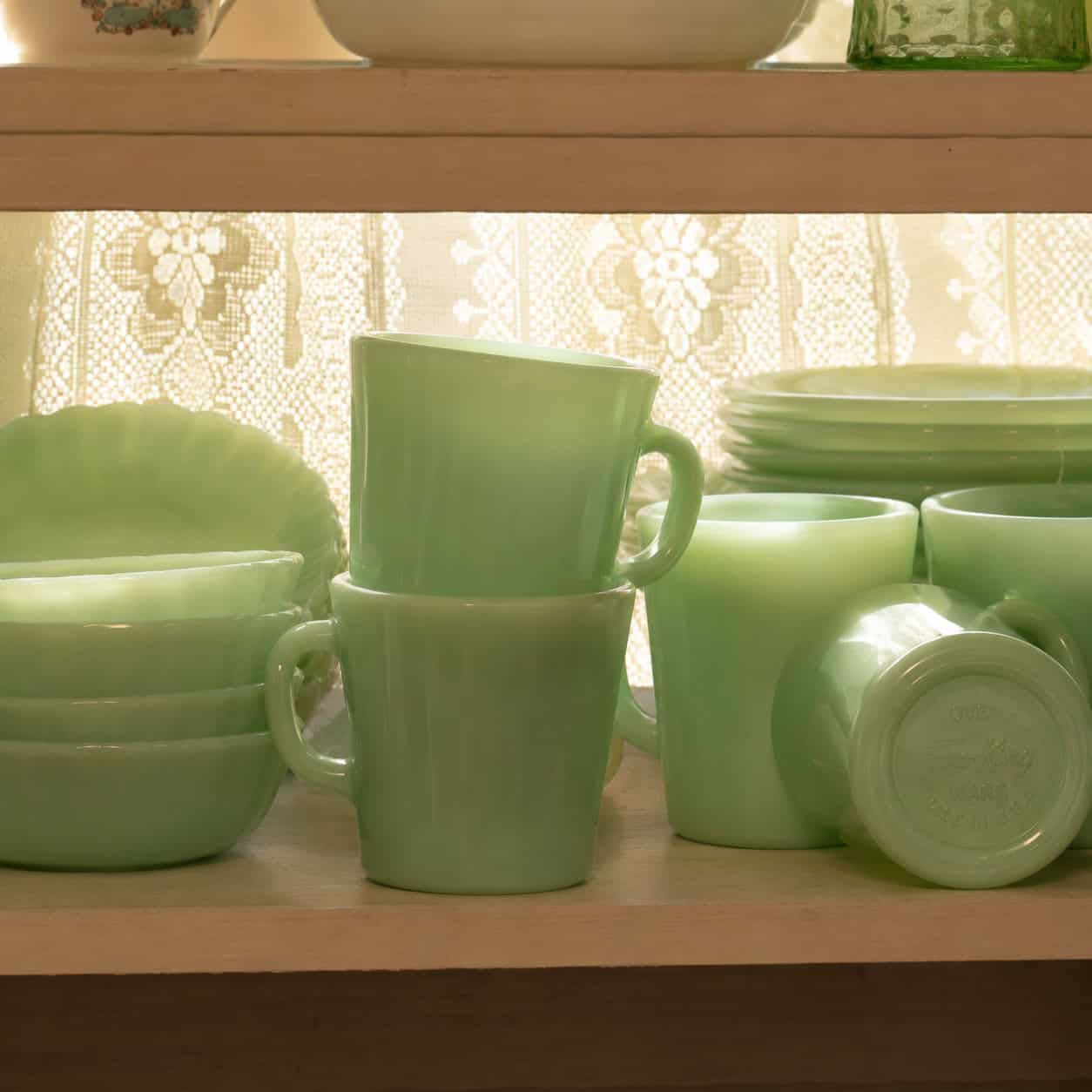
The milky-green dishes grandma loved. Everyone recognizes them.
Fire-King jadeite was so common it was given away free inside flour bags in the 1940s and ’50s. That everyday history is exactly why so much of it survived — and why the rare patterns now stand out.
Full sets bring hundreds. Scarce patterns like Sheaves of Wheat and Swirl push higher, and museum-grade pieces cross $1,000.
Look for early block-letter marks on the base, which point to older, more desirable production. The green should glow, not look chalky or worn.
One practical note: the oldest jadeite can carry lead in its glaze. Beautiful for a shelf. Keep the truly old pieces for display rather than daily meals.
5. ‘Radioactive Red’ Fiestaware
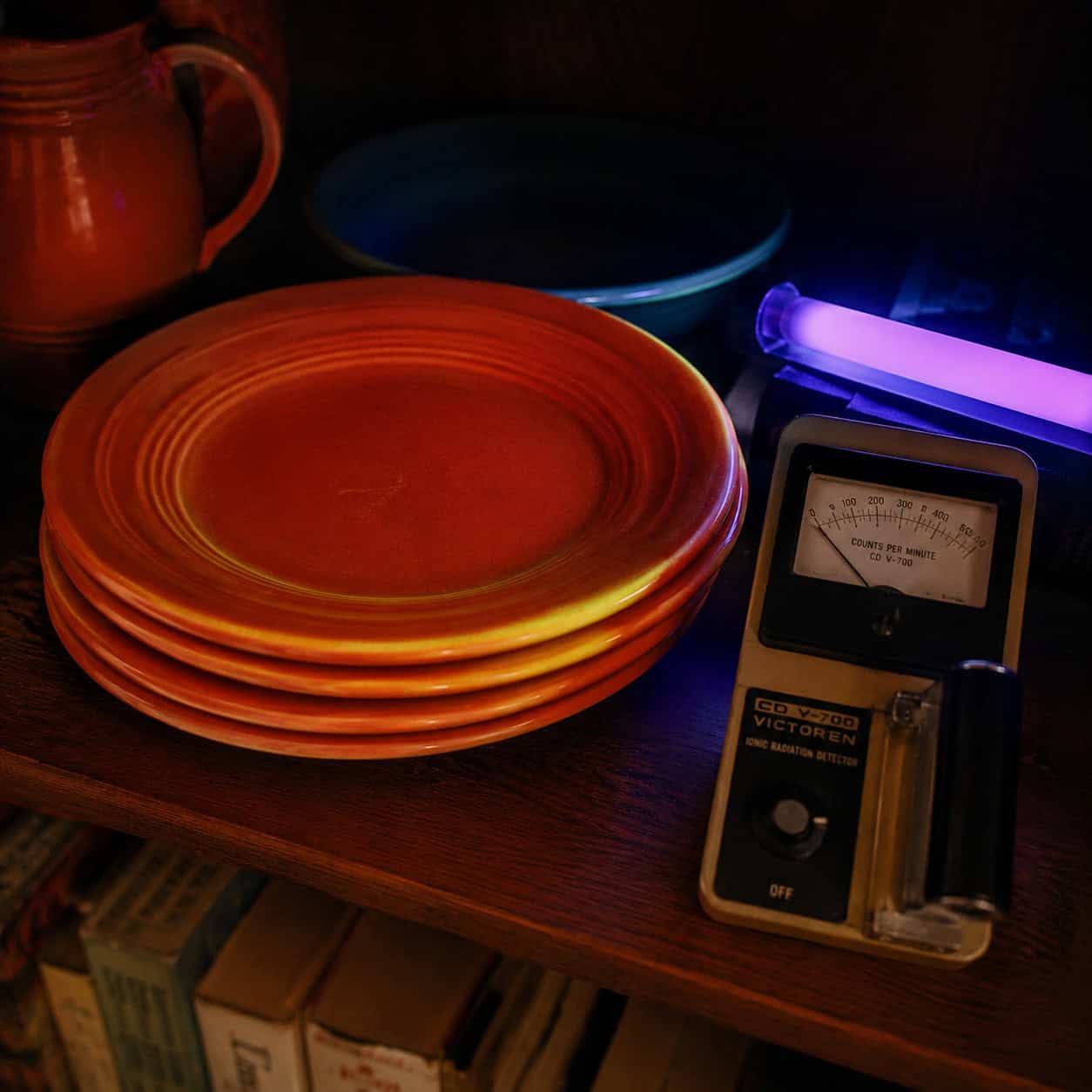
Here’s the one that stops people cold. Grandma’s cheerful red plates are, in the most literal sense, radioactive.
The original red Fiestaware glaze, made from 1936 to 1943, used natural uranium oxide to get that bold orange-red color. Homer Laughlin, the maker, stopped using uranium during World War II when the government took control of the supply, then revived a uranium-based red from 1959 to 1972 using depleted uranium.
And no, that fact doesn’t scare collectors off. It’s a selling point. “Radioactive red” is a genuine draw.
Now the safety part, because it deserves a straight answer. The ORAU Museum of Radiation and Radioactivity notes that these plates do emit measurable radiation — a Geiger counter will click over one. The consensus among health-physics sources is that displaying the dishes poses little concern. The real caution is about using them for food, especially acidic food like tomatoes or citrus, which can leach uranium from the glaze over time.
So the sensible move mirrors the jadeite: enjoy them on a shelf, not under your dinner.
Identifying the true vintage red matters for value. Original vintage red glows under a UV light and registers on a radiation detector. Modern Fiesta, relaunched in 1986, uses no uranium and is safe for the table — but it also doesn’t command the collector premium.
One more curveball: the rarest, most valuable original color isn’t the red at all. It’s medium green, produced only from 1959 to 1969. Fewer were made, fewer survived, and collectors pay accordingly.
Check the color, check the era, and when in doubt, a cheap UV flashlight tells you a lot before you ever call an appraiser.
6. Depression Glass in Rare Colors
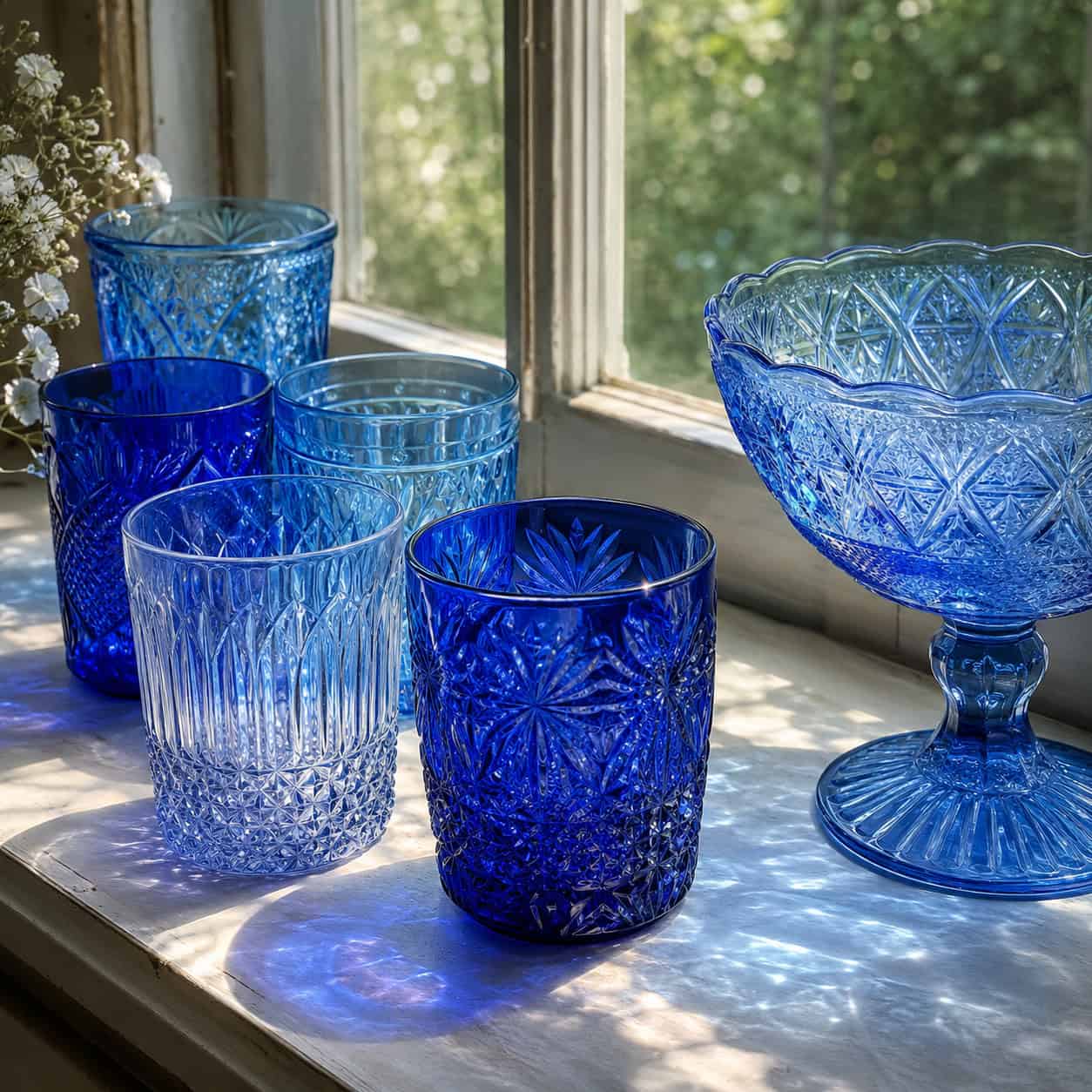
This glass was almost worthless when it was new. That was the point.
During the Depression, colored glassware was tucked into oatmeal boxes and handed out free at movie theaters on “Dish Nights” to get people through the door. Cheap then. Collectible now.
Color beats pattern every time. Cobalt Royal Lace and soft-blue Mayfair are the trophies — a set of blue Mayfair footed tumblers sold near $720, per Invaluable.
Watch for reproductions. Modern reissues flood the market, especially in the popular colors, and a fake in cobalt looks convincing at a glance.
Learn the genuine patterns and hold pieces to the light for the tell-tale mold seams and slight imperfections of the originals. Pink and green are common. Cobalt and true soft blue are where the money hides.
7. Fenton Hobnail Milk Glass
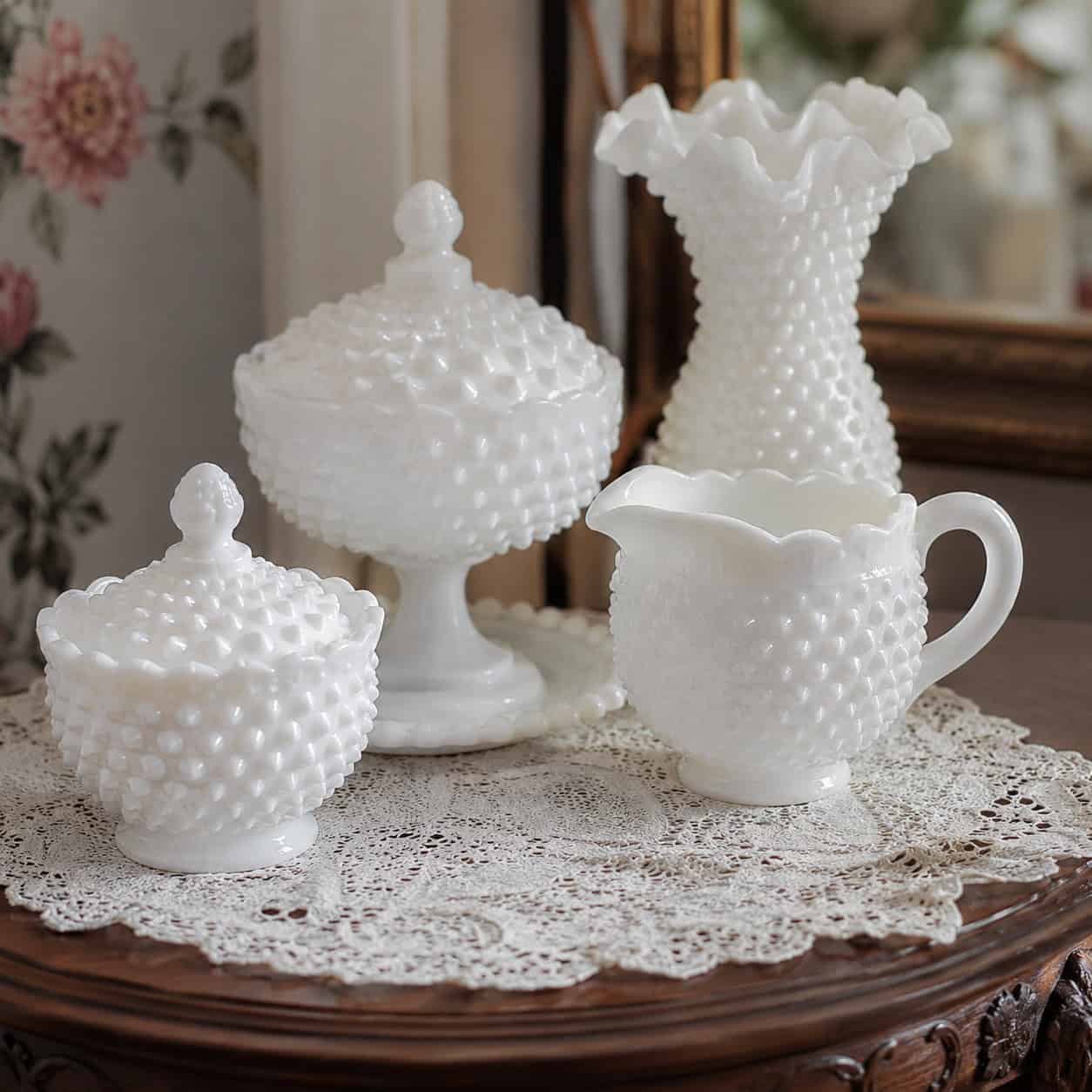
Bumpy white glass. Candy dishes, creamers, little vases with ruffled edges.
Fenton’s hobnail milk glass is quietly collectible. Individual pieces run $25 to $75, and rare or oversized items climb well past that.
The tell is the Fenton mark, usually pressed into the base. Milk glass itself is centuries old — the technique dates to the 1500s — but the mid-century Fenton pieces are what fill American cabinets.
Look for that dense, opaque white with no yellowing. A ring of the raised “hobnails” should be crisp, not worn smooth.
Not a jackpot item on its own. But a full set adds up, and it sells fast.
8. Hall China Teapots & Jewel Tea ‘Autumn Leaf’
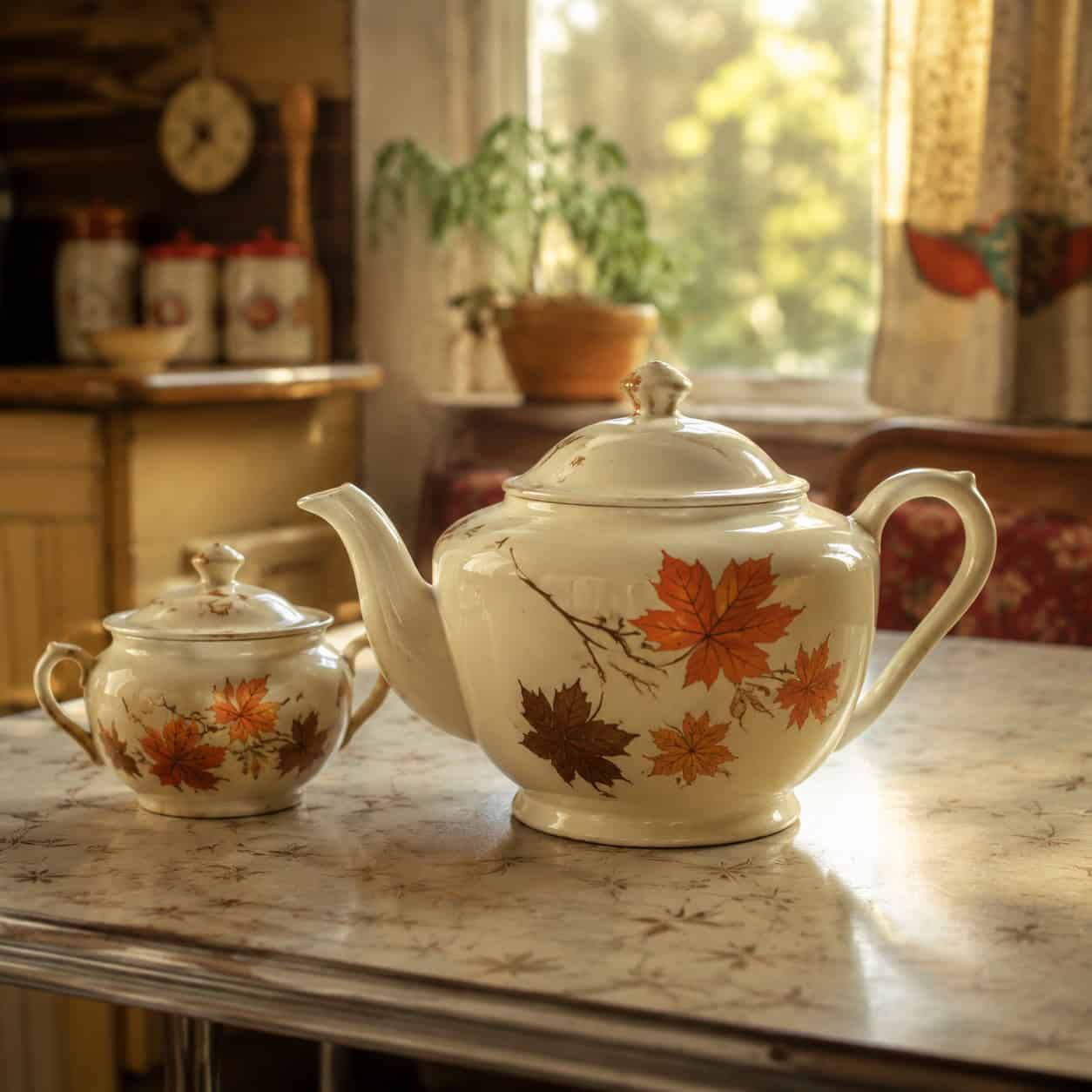
Great story here. The Autumn Leaf pattern was never sold in a single store.
From 1933 to 1978, Jewel Tea salesmen sold it door to door as a loyalty premium for grocery customers. That means every piece walked into a home on a delivery route, one warm afternoon at a time.
Hall China made the wares, and their teapots from the 1920s through the 1950s are collectible in their own right. The early 1930s and ’40s Autumn Leaf shapes and the scarce serving pieces command the strongest prices.
Watch for reissues. The National Autumn Leaf Collectors Club commissioned newer pieces, and separating those from original Jewel Tea production changes the value considerably.
Bottom marks and shape styles are your guide. When the pattern still glows and the piece predates 1950, you’ve got the good stuff.
9. Ceramic Cookie Jars (McCoy, Hull, Regal)
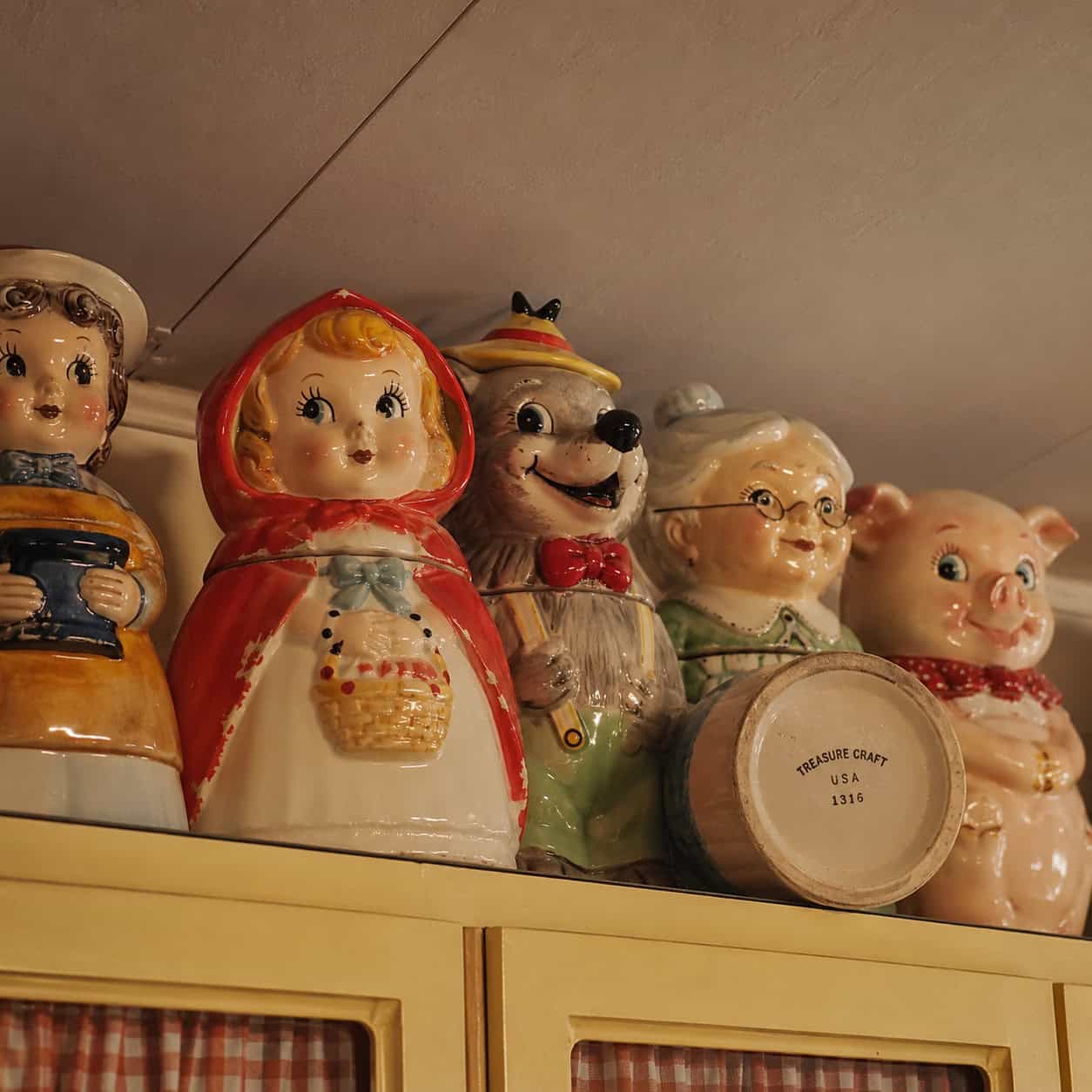
The quirkier the jar, the bigger the payday.
McCoy, Hull, and Regal made figural cookie jars from the 1930s through the ’50s — animals, characters, storybook figures. Hull’s Little Red Riding Hood runs $100 to $300, and rare figural jars have reached $1,000.
Andy Warhol collected them obsessively. When his cookie-jar collection went to auction, it sold for a small fortune, which tells you plenty about how a “silly” object becomes serious money.
Condition is critical. Chips on the lid, hairline cracks, and repainted spots all gut the value.
Turn the jar over for the maker’s mark and check that the lid is original to the base. The jar is worth far more than the cookies ever were.
10. Mason Jars in Rare Colors
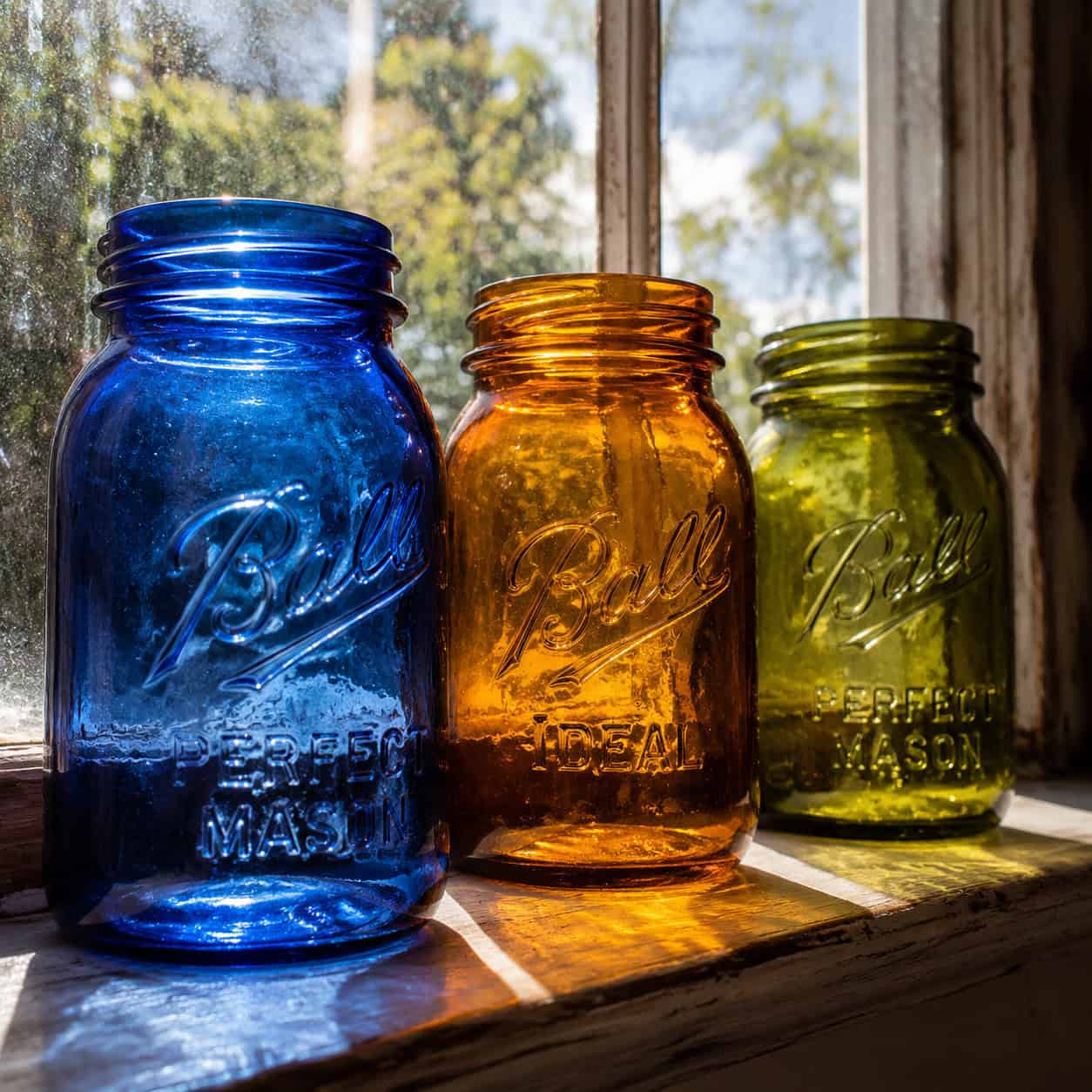
The penny jar could be a payday.
Ordinary clear or aqua Ball jars are worth a few dollars. The color changes everything. Cobalt blue, amber, olive, and unusual embossing turn a canning jar into a collectible.
A Ball Perfect Mason in olive amber has hit around $380. Rare specimens and scarce off-brands — an old Van Vliet jar, for instance — climb into the thousands.
Ball jars date back to the 1880s, and some brands stretch to 1859. Older, hand-finished jars with wavy glass and bubbles are the interesting ones.
Hold each jar up to a window. If it throws an odd color — anything but the usual clear or pale aqua — set it aside and look up the embossing before it goes in the recycling.
11. Copper Pots, Pans & Mixing Bowls
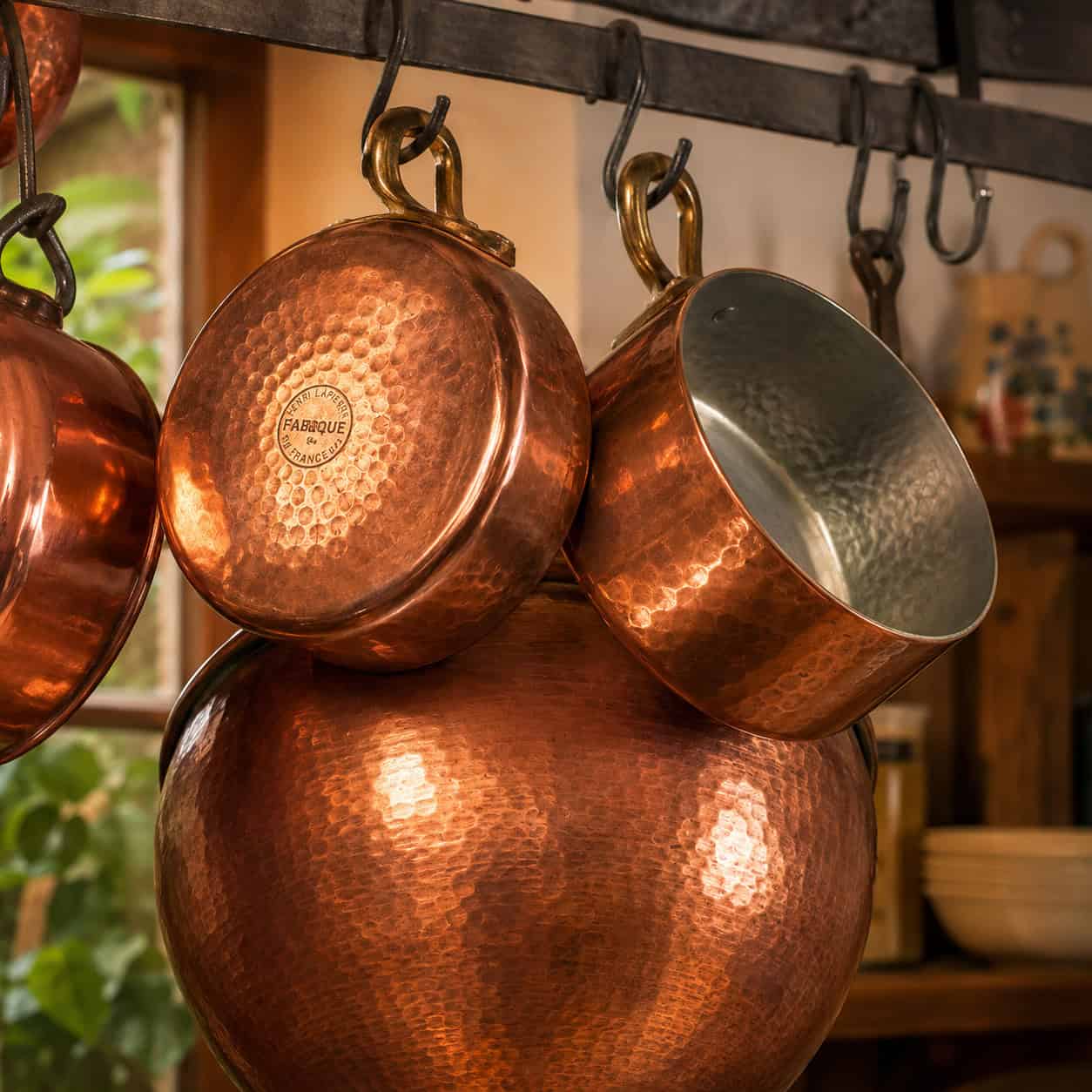
Copper is back on kitchen walls as display cookware, and the antique stuff leads the pack.
Value rides on three things: age, the thickness of the copper, and the condition of the inner tin lining. A worn-through lining knocks the price down; an intact one lifts it.
A five-piece set dated to 1899 was listed above $1,100. Heavy, hand-hammered pieces from named French makers pull the strongest interest.
Weight tells the tale. Thin, light copper is decorative. Thick, heavy-gauge copper was made to cook and holds its value.
Don’t polish away a maker’s stamp trying to make it shine. Collectors want the mark more than the gleam.
12. Revere Ware Copper-Bottom Cookware
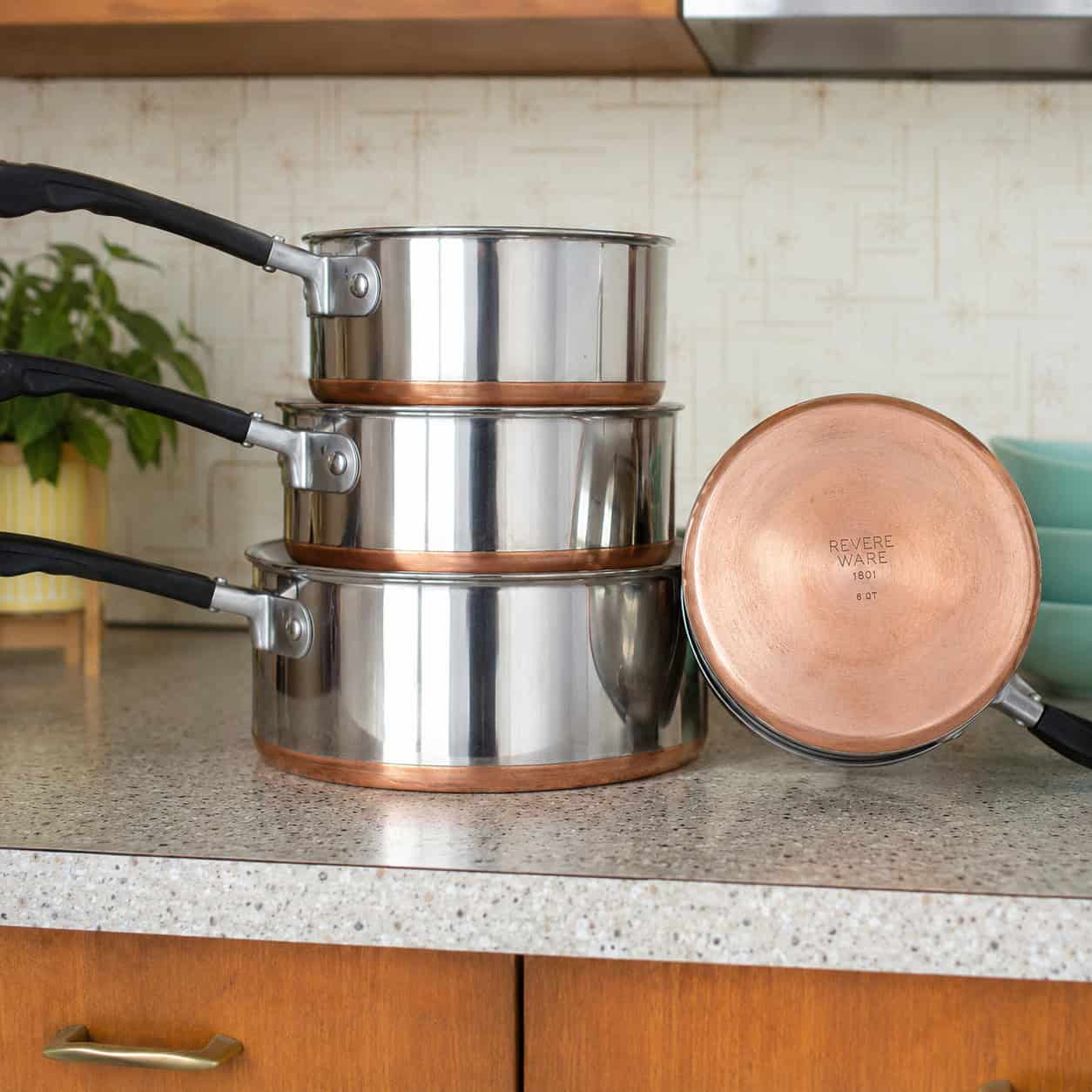
The shiny stainless pans with the copper-clad bottoms. Nearly everyone owned a set.
Revere Ware ran from the 1930s through the ’60s and beyond, and the early pieces are the rising favorites. Clean examples with distinctive early markings can bring several hundred dollars.
Flip the pan and read the stamp. Earlier production, marked with specific process patents and pre-war logos, is what separates a $10 pan from a $200 one.
The copper bottom should be solid, not peeling or dented flat. Original lids and matching sets help.
This is a check-your-cabinet item. You may already own the collectible version without knowing it.
13. Sterling & Antique Silverware Sets
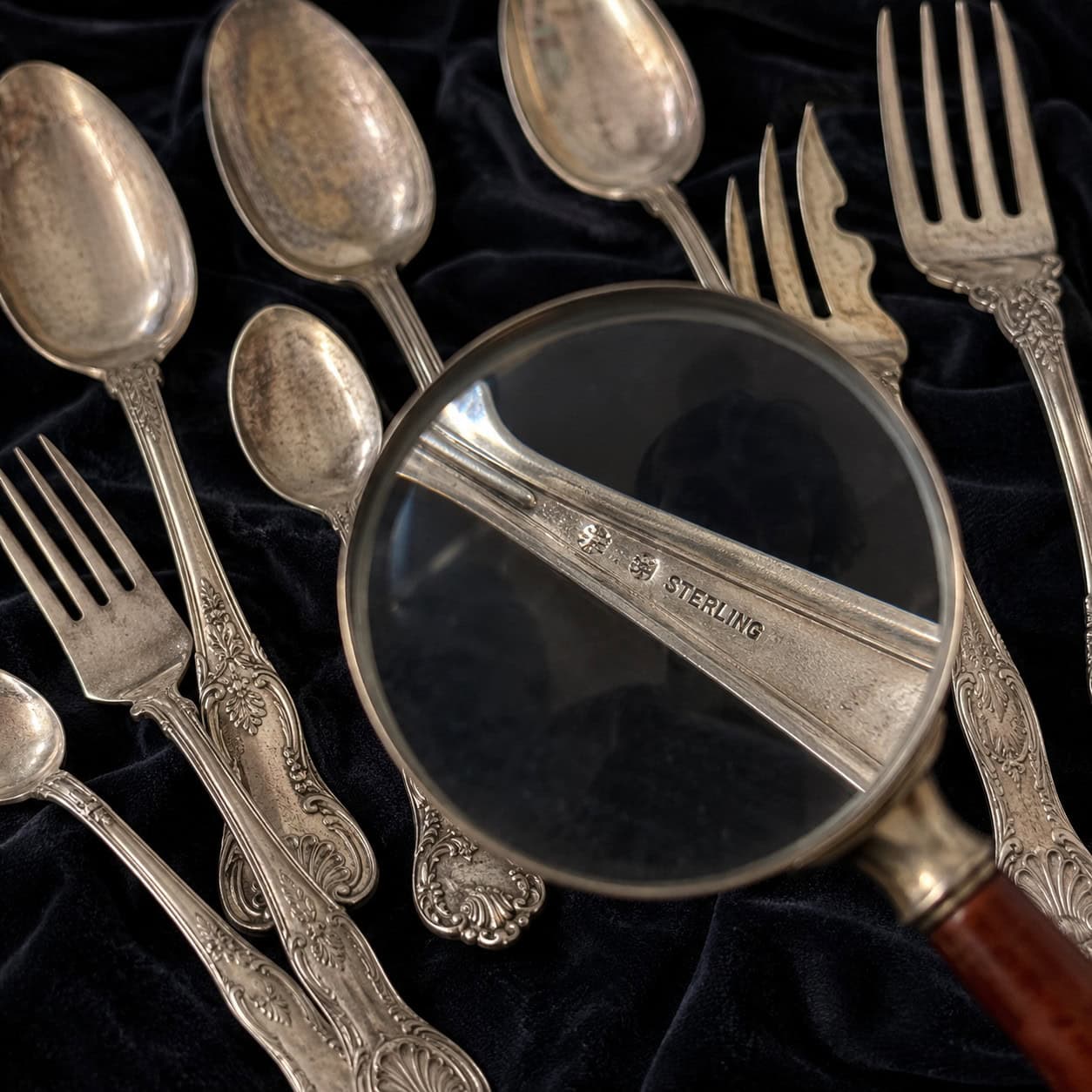
Once the ultimate wedding gift. Now it sits forgotten in a drawer, tarnished, and most people have no idea whether it’s worth $40 or $4,000.
The first thing to settle is the single most important question: is it sterling, or is it silver-plate? The gap between the two is enormous.
Sterling is 92.5% pure silver all the way through. It’s almost always marked — look for the words “STERLING,” the number “925,” or a maker’s hallmark stamped on the back of the handle or the underside of a spoon. Plate is a thin layer of silver over a base metal, and it’s usually marked “EPNS,” “silverplate,” “A1,” or a brand name like Rogers with no sterling stamp.
A quick field check: sterling is heavier in the hand and won’t stick to a magnet. But the marks are the real proof, so grab a magnifier and read them.
Now the money, because there are two separate values and they matter differently.
Melt value is what the raw silver is worth by weight — it moves with the daily silver spot price and sets a floor under any sterling piece. Collector value is what a complete, sought-after set by a respected maker is worth as an object, and it can run far above melt.
Here’s the practical rule. A beat-up, mismatched pile of sterling is worth its melt weight. A complete, patterned set by a name like Tiffany, Gorham, or Reed & Barton is worth keeping whole and selling to a collector. An incomplete antique Tiffany & Co. set has listed for $1,400 — well beyond what its metal alone would fetch.
Pre-1960s wedding silver tends to bring the best prices, both for craftsmanship and for the patterns collectors chase. Don’t scrap a named set for melt without checking the collector market first — you can leave serious money on the table.
Silver-plate, by contrast, has almost no melt value. Its worth is decorative, and only a rare ornate piece brings much. Sort the sterling from the plate before you decide anything.
14. American Brilliant Cut Crystal
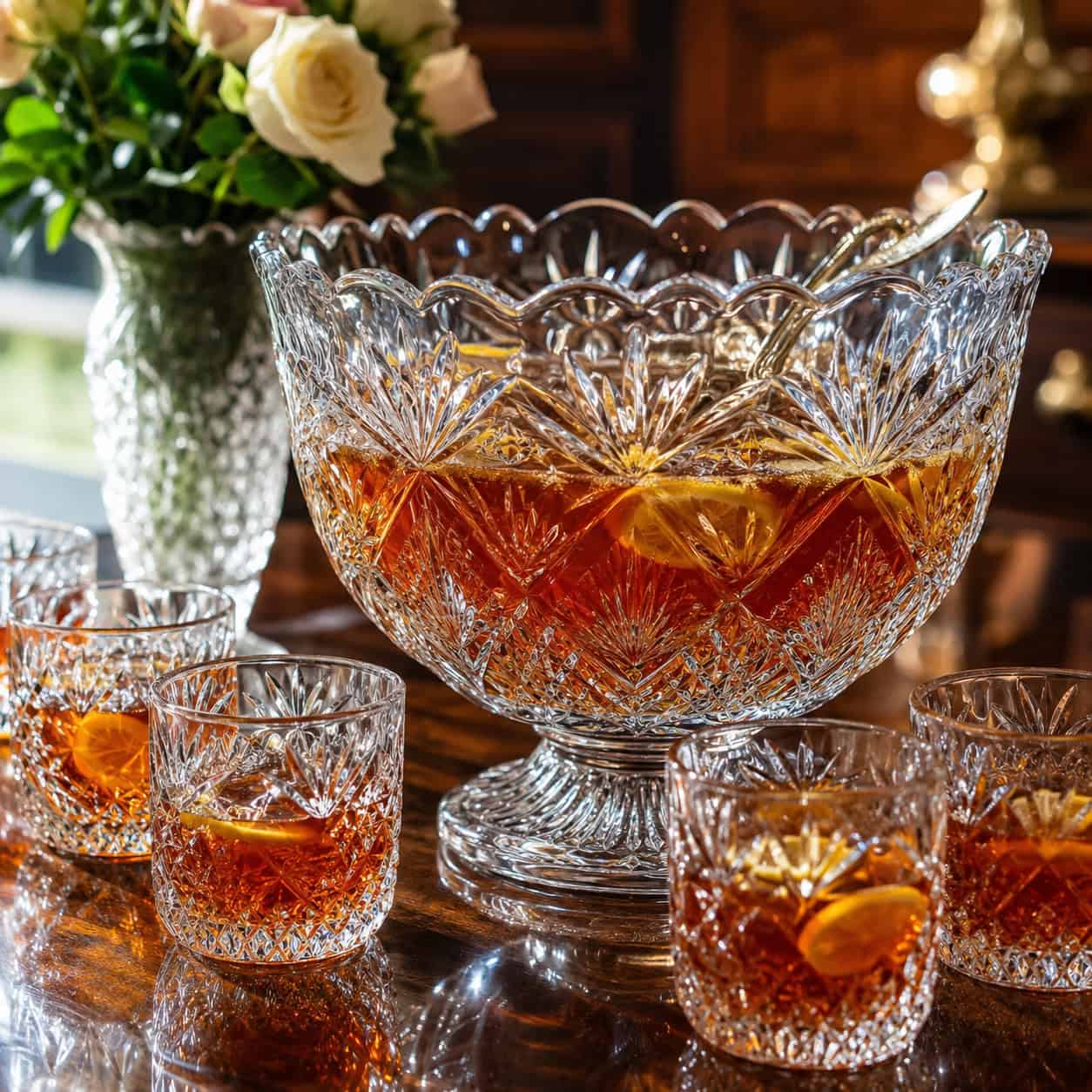
Grandma’s punch bowl might be a sleeper.
The American Brilliant period ran from the late 1800s into the early 1900s, when glassmakers cut deep, intricate patterns into thick lead crystal by hand. The result throws light like a prism.
Dr. Lori’s tells are worth memorizing: look for exceptional clarity, sharp light-catching sparkle, and a faint silvery sheen across the surface. Run a finger over the cuts — they should feel crisp and deep, not shallow or molded.
Tumblers, bowls, and big punch sets can be genuinely valuable, far more than the machine-cut glass that came later.
Tap the rim gently. Good lead crystal rings with a long, clear tone. That ring, plus razor-sharp cuts, is the sound of money.
15. Sunbeam Mixmaster Stand Mixers
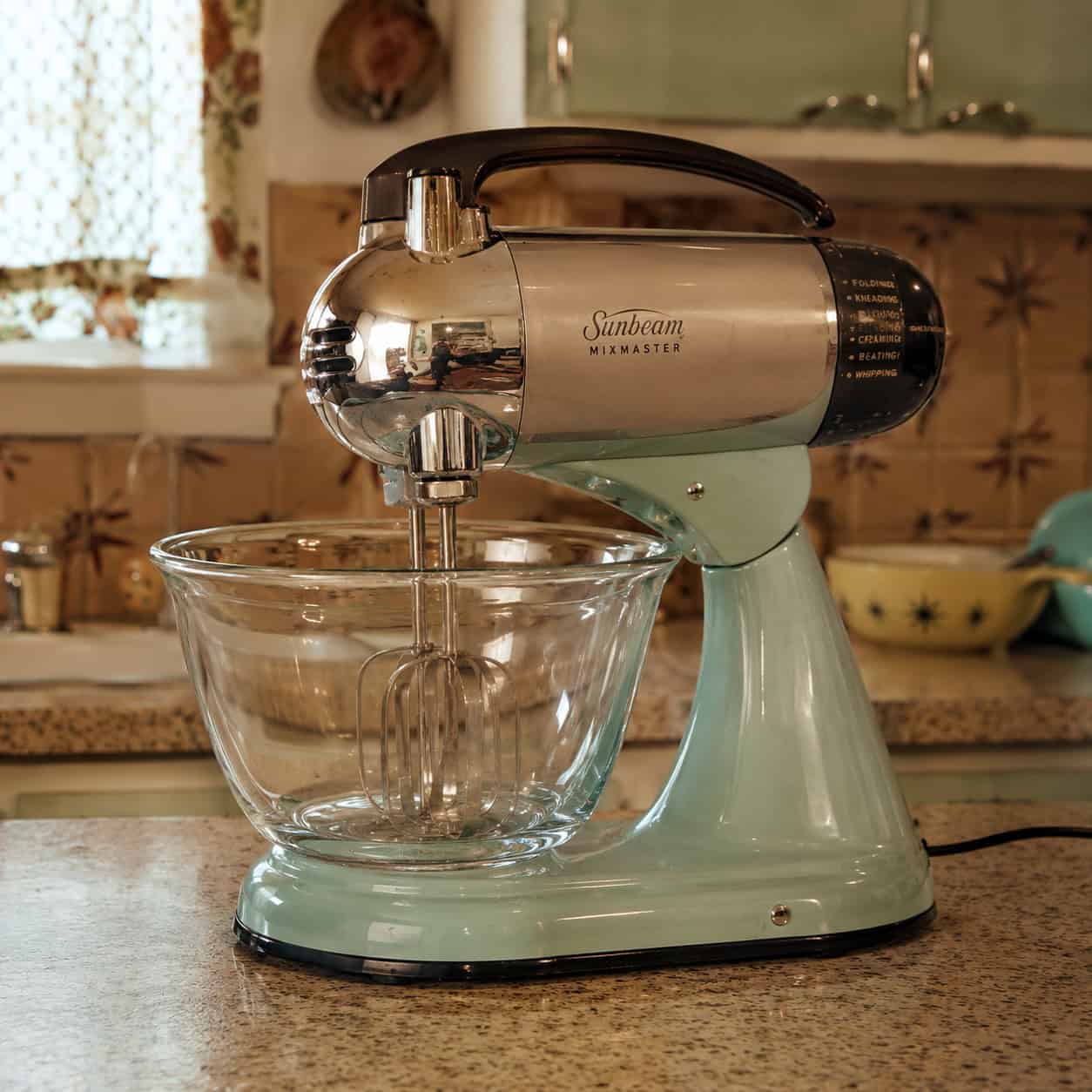
Before KitchenAid ruled the counter, the Sunbeam Mixmaster did.
These mid-century stand mixers were the workhorse of American baking, and nostalgia has turned clean working examples into retro décor with a price tag.
Completeness drives the value. A Mixmaster with its original bowls and both beaters is worth far more than a bare motor head.
Chrome should be bright, the cord safe, and the motor should still run through its speed settings without grinding.
Pastel and two-tone models photograph beautifully on a farmhouse counter, which is exactly why buyers want them.
16. Bakelite-Handled Utensils & Flatware
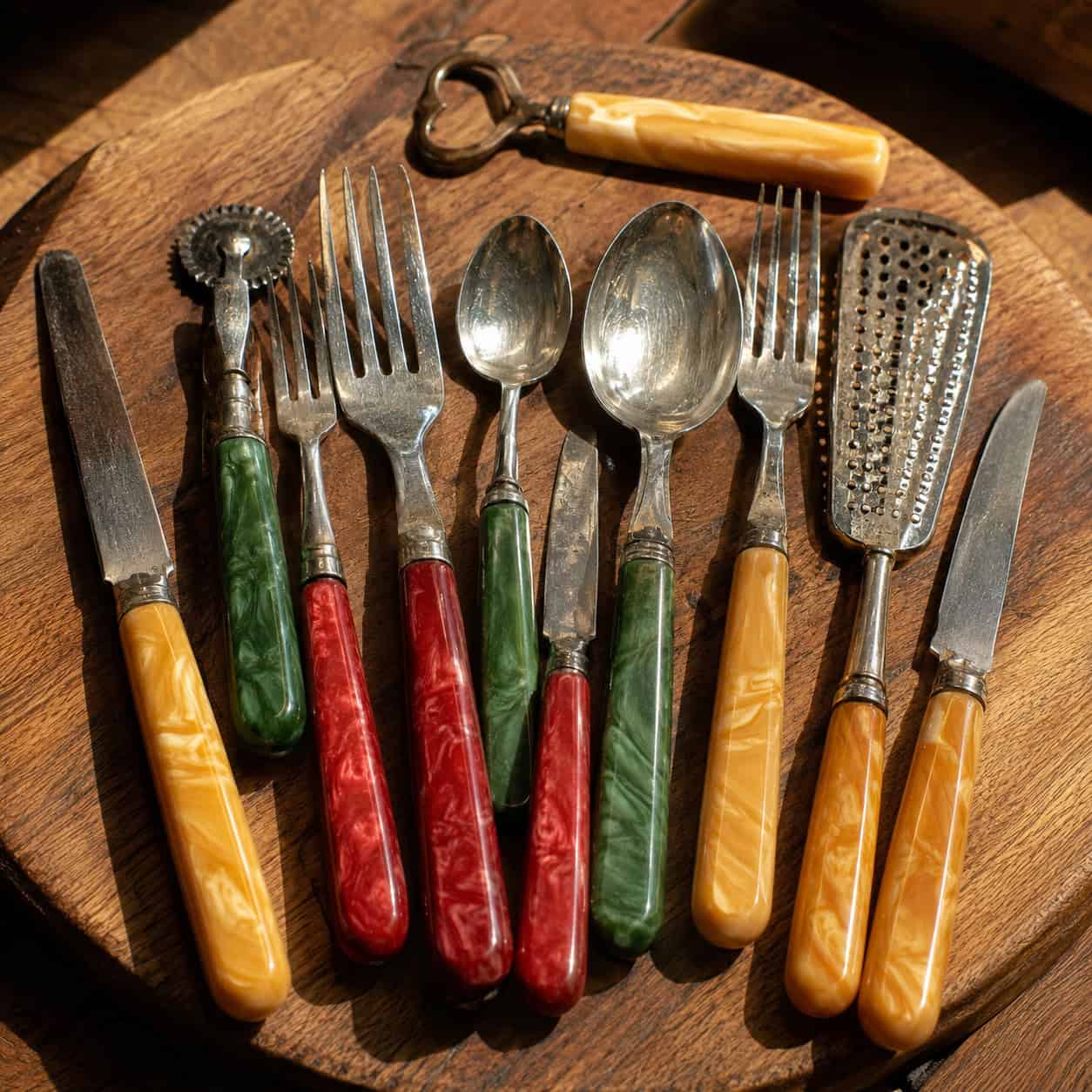
Butterscotch. Cherry red. Deep green. Those funky handles are hot.
Bakelite and its cousin Catalin were early plastics used on knife handles, serving pieces, and kitchen gadgets in the 1930s and ’40s. The bright, marbled colors are what collectors chase.
Single lots move big — a run of 250 Bakelite pieces sold for $650, and standout colorful Catalin handles pull real premiums individually.
There’s a simple test. Rub the handle briskly until it warms, and true Bakelite gives off a faint chemical smell some describe as formaldehyde. A dab of hot water works too.
Green and red tend to top the color hierarchy. Plain black and brown are worth less, so sort by color first.
17. Antique Graniteware & Enamelware
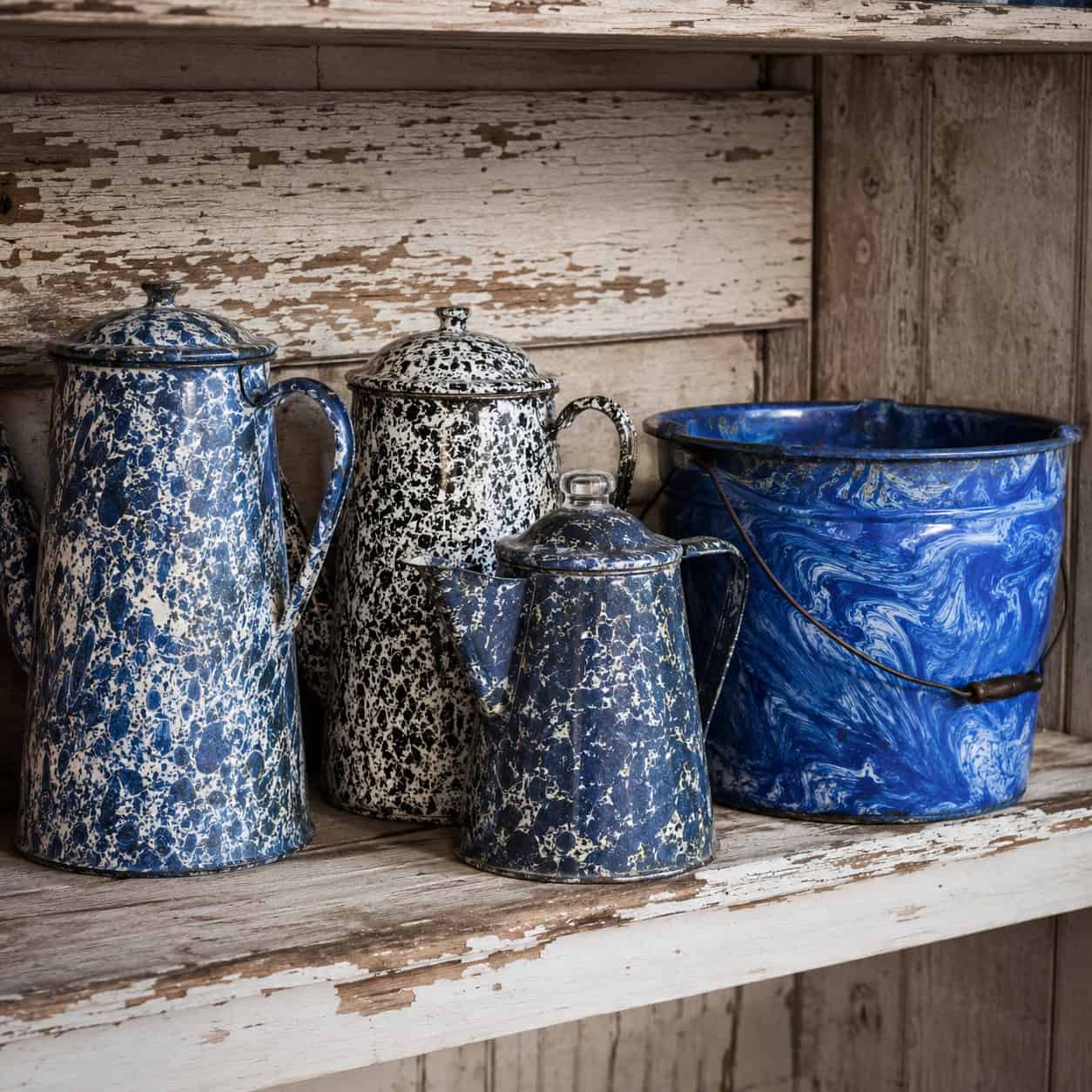
The speckled, swirled coffee pots and pails from the farmhouse. This is where the story gets scarce.
Graniteware was made from the 1870s through the end of World War II, and pre-1900 pieces hold the top value. Many older pieces vanished into wartime scrap drives, which thinned the survivors and pushed prices up.
Color rules the value. Common white and gray are affordable; purple, brown, green, and cobalt swirl are the prizes. A perfect rare muffin tin can reach $500 to $800 and beyond, according to Collectors Weekly.
Chips and rust are expected on utilitarian ware, but heavy damage still hurts. A rare color with a vivid, unbroken swirl is what to look for.
Turn the piece in good light. If the swirl is dramatic and the color unusual, you’re holding the good end of the range.
18. Vintage Tupperware in Rare Colors
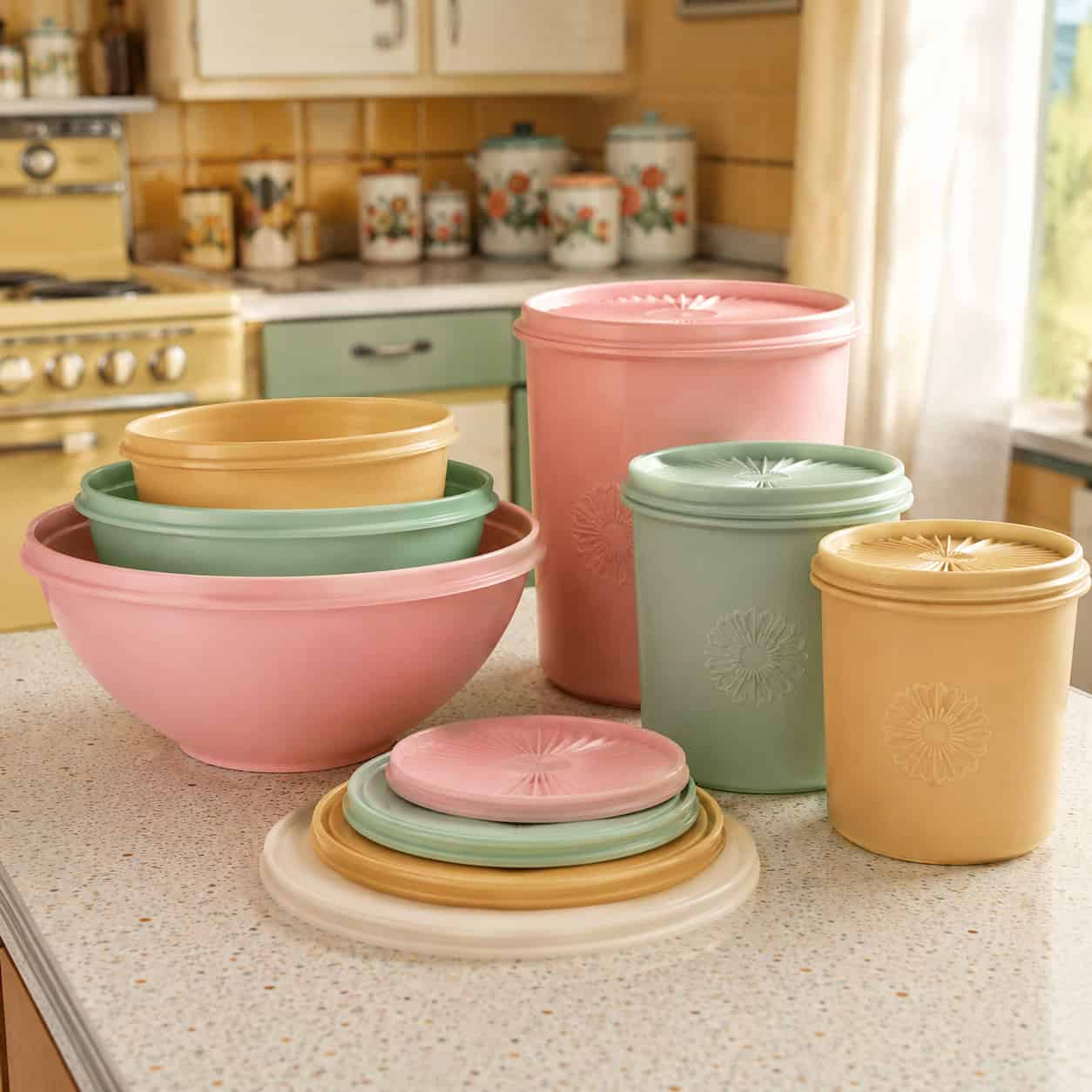
Peak nostalgia. The pastel containers from grandma’s Tupperware parties.
Everyday Tupperware is worth little. But complete sets in scarce colors from the 1950s through the ’70s sell for $50 to $100 and up, driven by younger buyers who love the retro palette.
Design plus nostalgia is the engine. A matching nesting set of bowls or a full canister lineup in soft pinks, mints, and ambers is the target.
Cracks, warping, and stains from decades of leftovers kill the value. You want pieces that still snap shut and burp their seal.
Original “Wonderlier” bowls and the classic tumblers are the recognizable stars. Check the color before you toss the plastic.
19. Colored Aluminum Tumblers
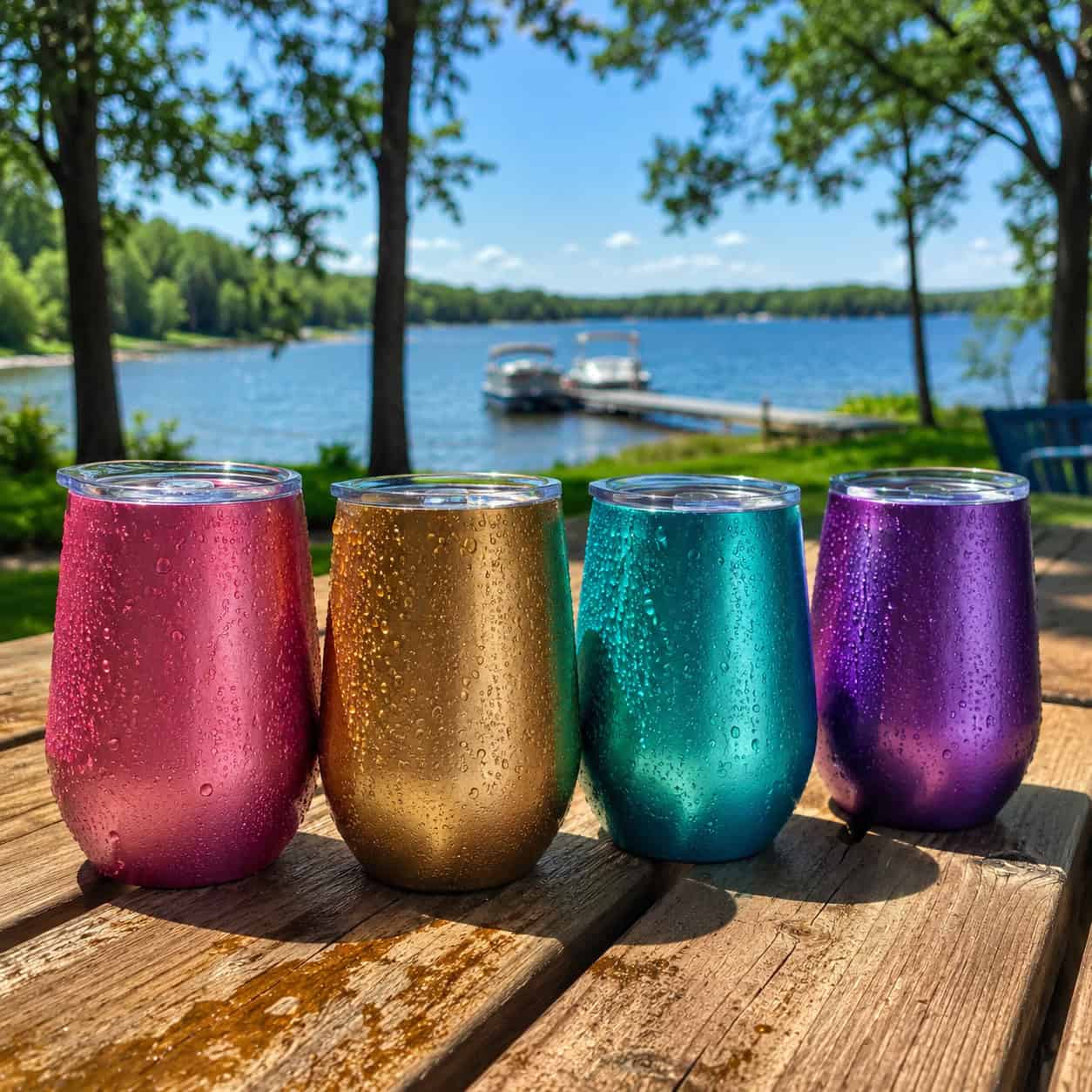
Those jewel-toned metal cups that made your teeth ache with cold.
Anodized aluminum tumblers were everywhere in the 1950s and ’60s — pink, gold, teal, purple, all in a matching set on the picnic table.
A full, color-matched set in good condition can fetch $50 to $100 or more. Loose singles are worth little; the set is the thing.
The finish scratches and dulls, so buyers want bright, unpitted color. Pinholes and heavy dents drop the price fast.
Light, cheerful, easy to display. If grandma’s set is complete and shiny, it’s small money made simple.
20. Carbon-Steel Chef’s Knives (Sabatier, F. Dick)
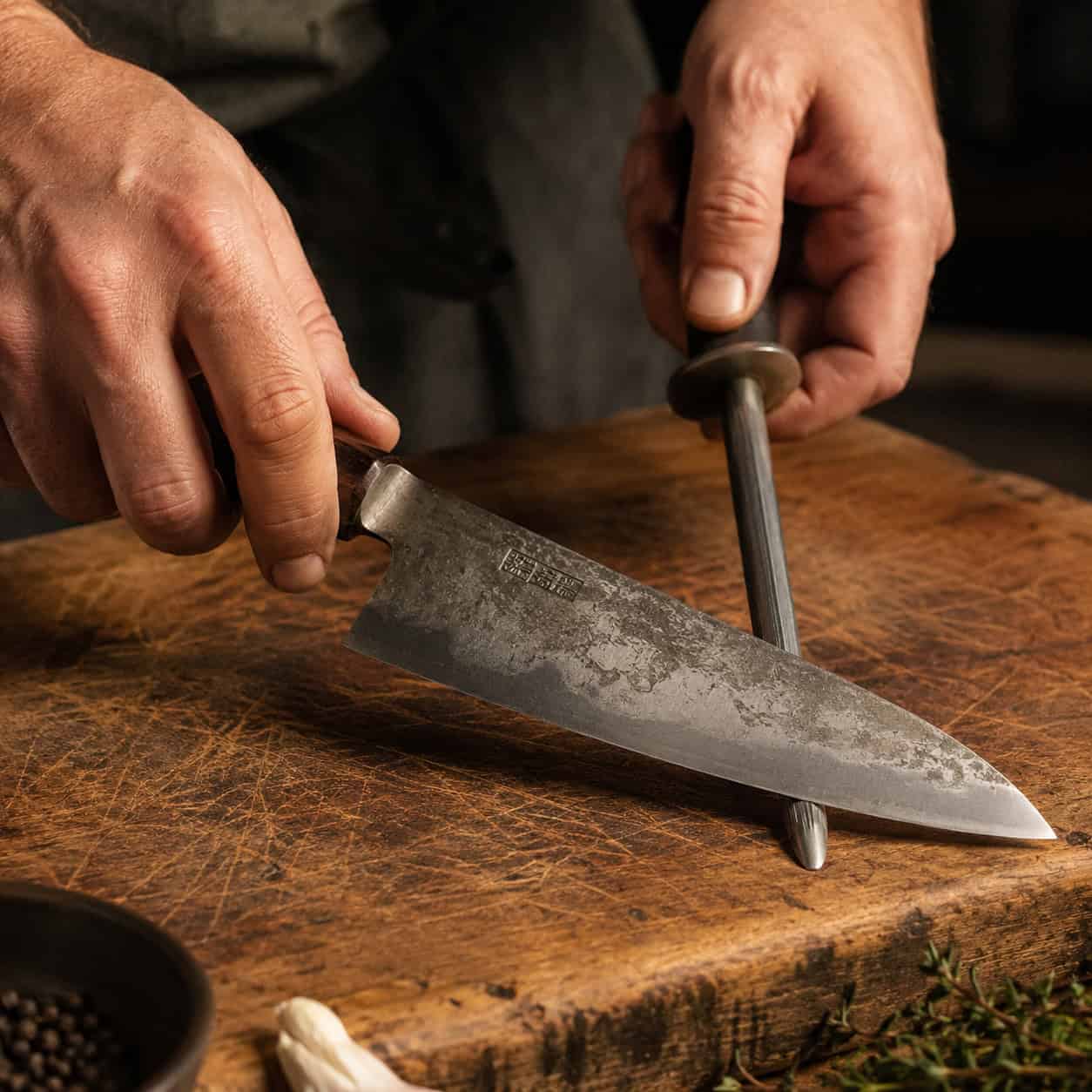
The rust-prone blade grandma babied and dried after every wash. Serious cooks want it back.
Carbon steel takes a sharper, keener edge than stainless, and named French and German makers built the best of it. Sabatier and F. Dick are the names to know.
Good vintage examples have listed as high as $500. The value is in the steel and the maker’s stamp, not in a mirror polish.
A dark patina is fine — expected, even. What matters is a straight spine, a blade that hasn’t been ground down to a sliver, and a solid handle.
This is the serious-cook counterpoint to the decorative pieces on this list. Someone will actually cook with it.
21. Vintage Mechanical Kitchen Scales
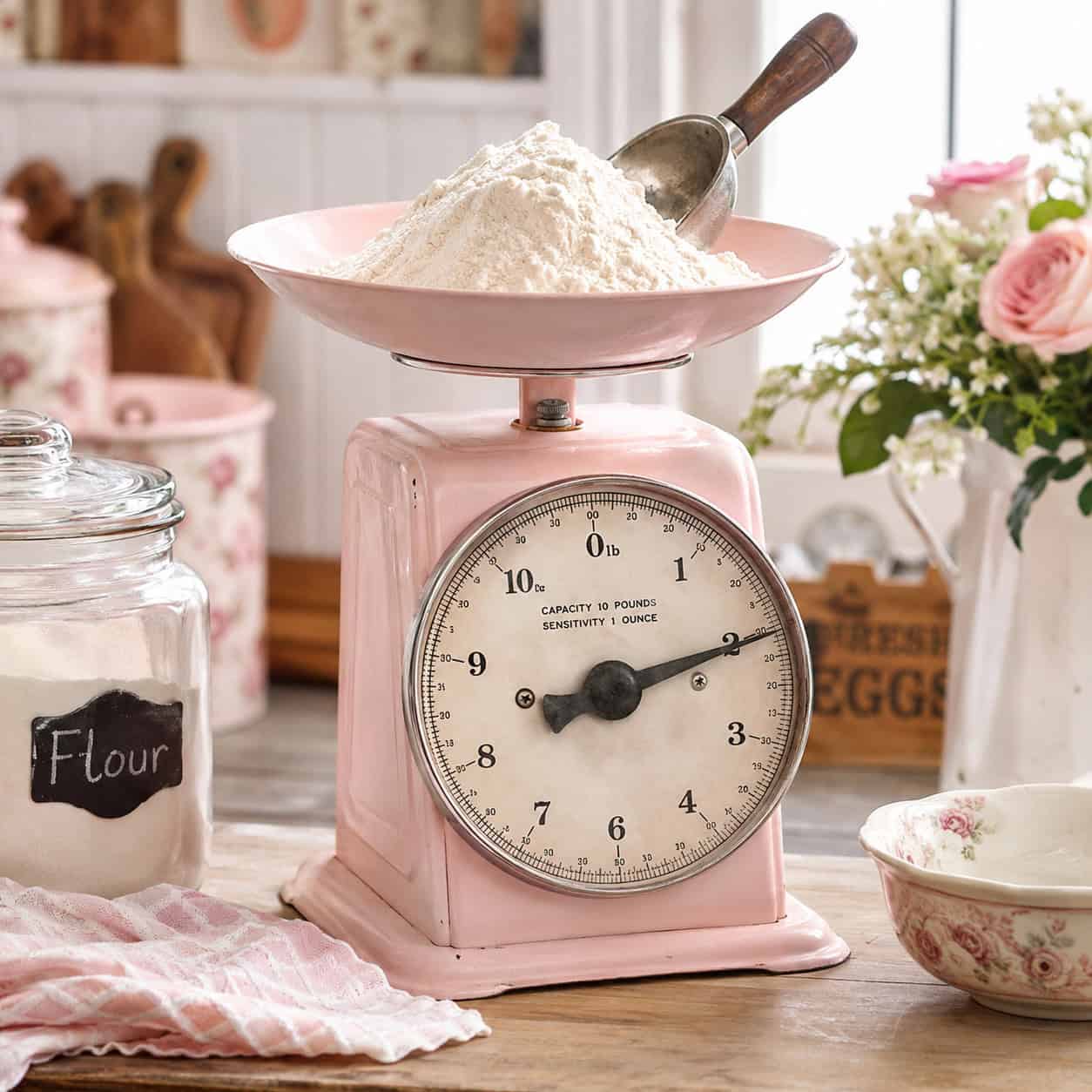
The old spring scale for weighing flour is now a farmhouse-kitchen décor gem.
Mechanical scales from mid-century — the ones with a needle and a dial, no batteries anywhere — ride the same retro wave that made everything else on this list collectible.
Brands like Hanson and Detecto in stainless or soft pastel colors draw steady buyer interest for exactly that farmhouse look.
Working matters less than you’d think, since most buyers display them. But a needle that still moves and a legible dial help the sale.
Pastel pink or mint in clean condition sits at the top. Rusted and dented drops to the bottom.
22. Coca-Cola Glasses & Serving Trays
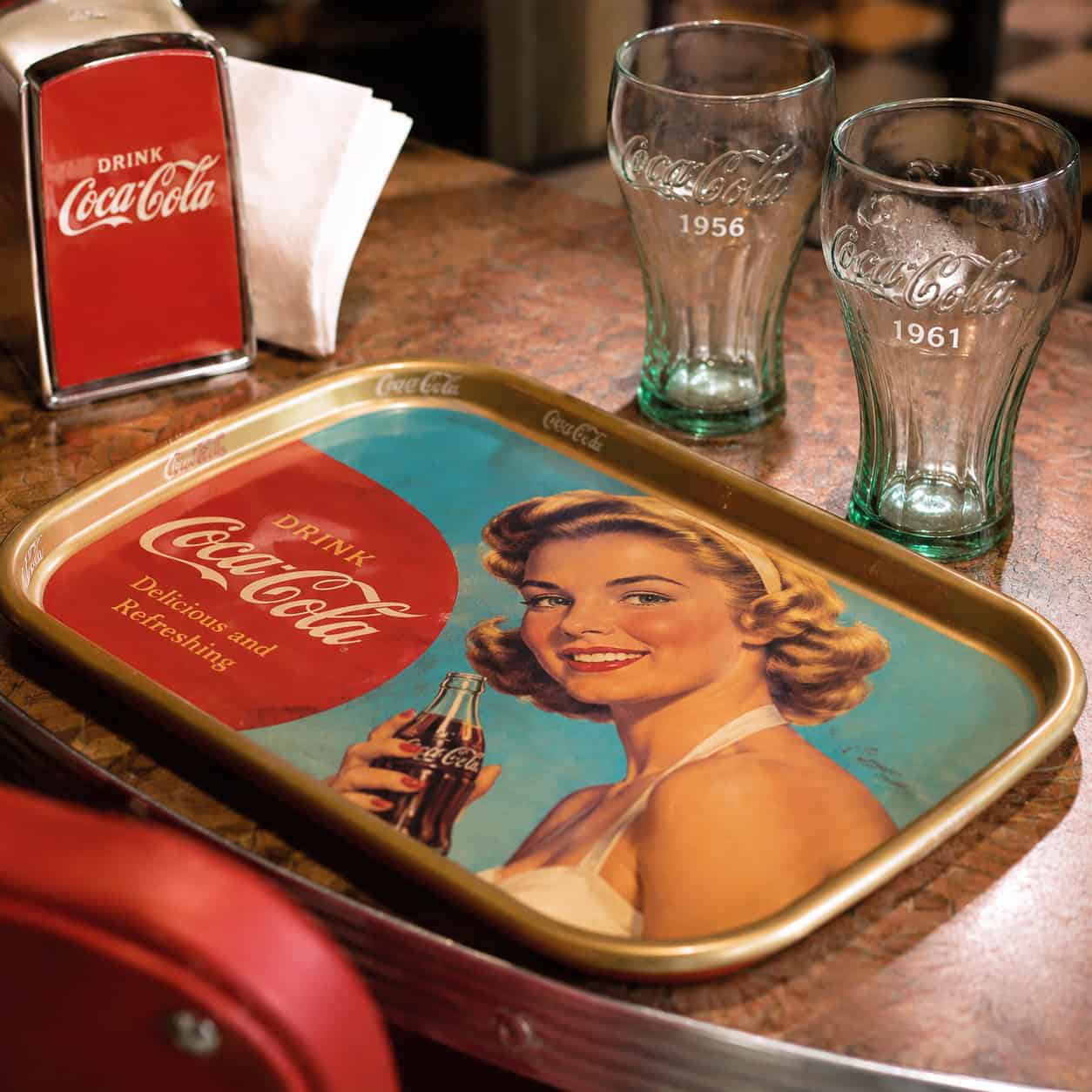
A slice of Americana hiding in the cupboard.
Mid-century Coca-Cola advertising glasses and serving trays sell for $50 to $200 each, and the ones with a clear date stamp or dated logo bring the most.
The dated logo is the whole game. Coke changed its script and artwork over the decades, so a readable date on the tray or the glass lets a collector place it exactly.
Trays should have bright lithography with minimal rust or scratches. Glasses need crisp, unfaded printing.
Reproductions are everywhere, so learn the genuine dated pieces. When you find the real thing tucked behind the everyday glasses, it’s found money.
23. Pink Depression ‘Cherry Blossom’ by Jeannette
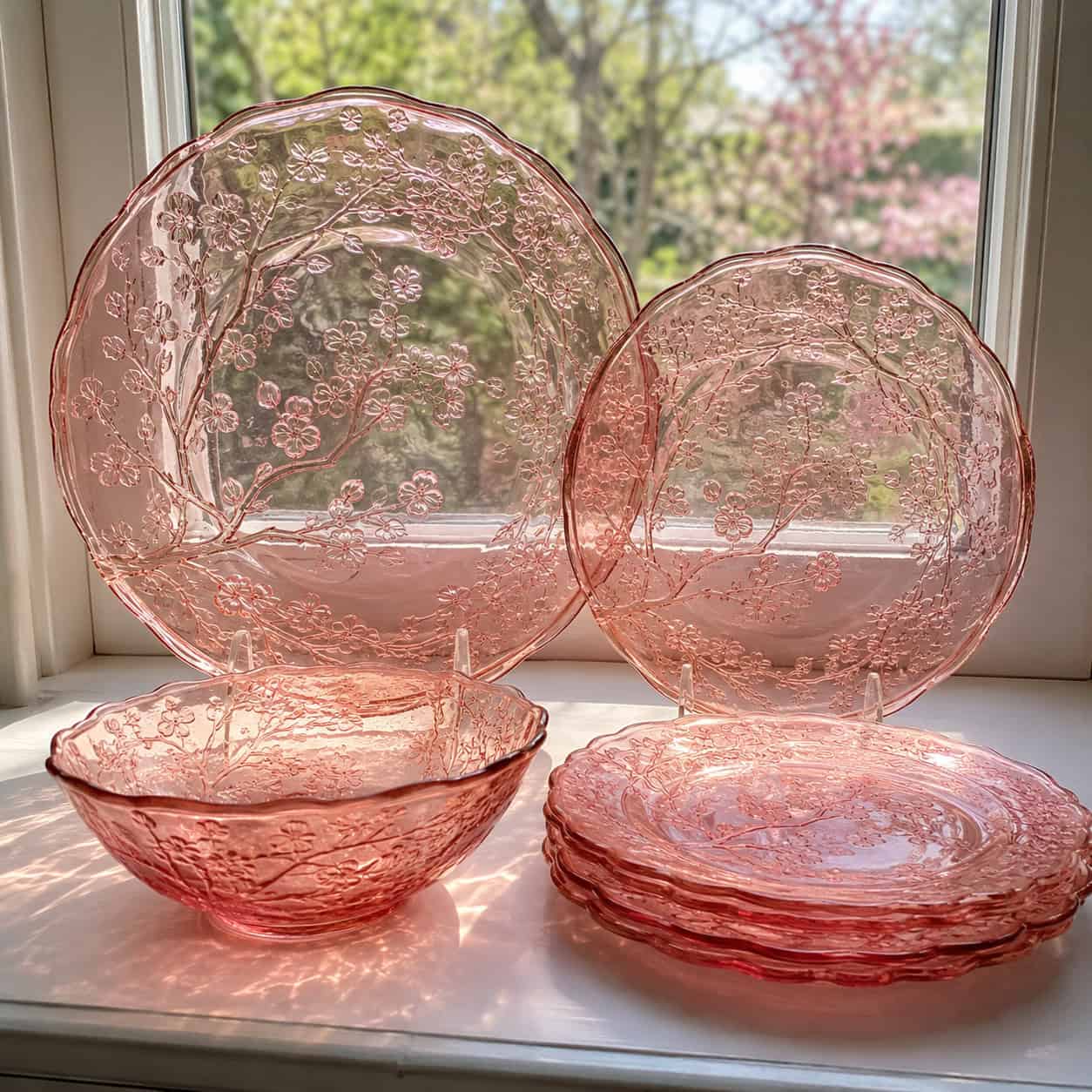
One pattern, one color, one big reproduction warning.
Jeannette Glass made Cherry Blossom from 1930 to 1939, and the pink version is the collector favorite. The dainty cherry-and-branch motif pressed into soft pink glass is instantly recognizable.
It’s also one of the most reproduced patterns in all of Depression glass. Fakes have circulated for decades, and some are good enough to fool casual buyers.
Learn the tells. Original Cherry Blossom has fine detail in the cherries and leaves, correct proportions, and the slight imperfections of period glassmaking. Repros often look too crisp, too heavy, or slightly off in color.
A genuine pink set in good condition commands strong prices. A room full of reproductions commands almost nothing — so verify before you celebrate.
24. Enamelware in the Cathrineholm ‘Lotus’ Pattern
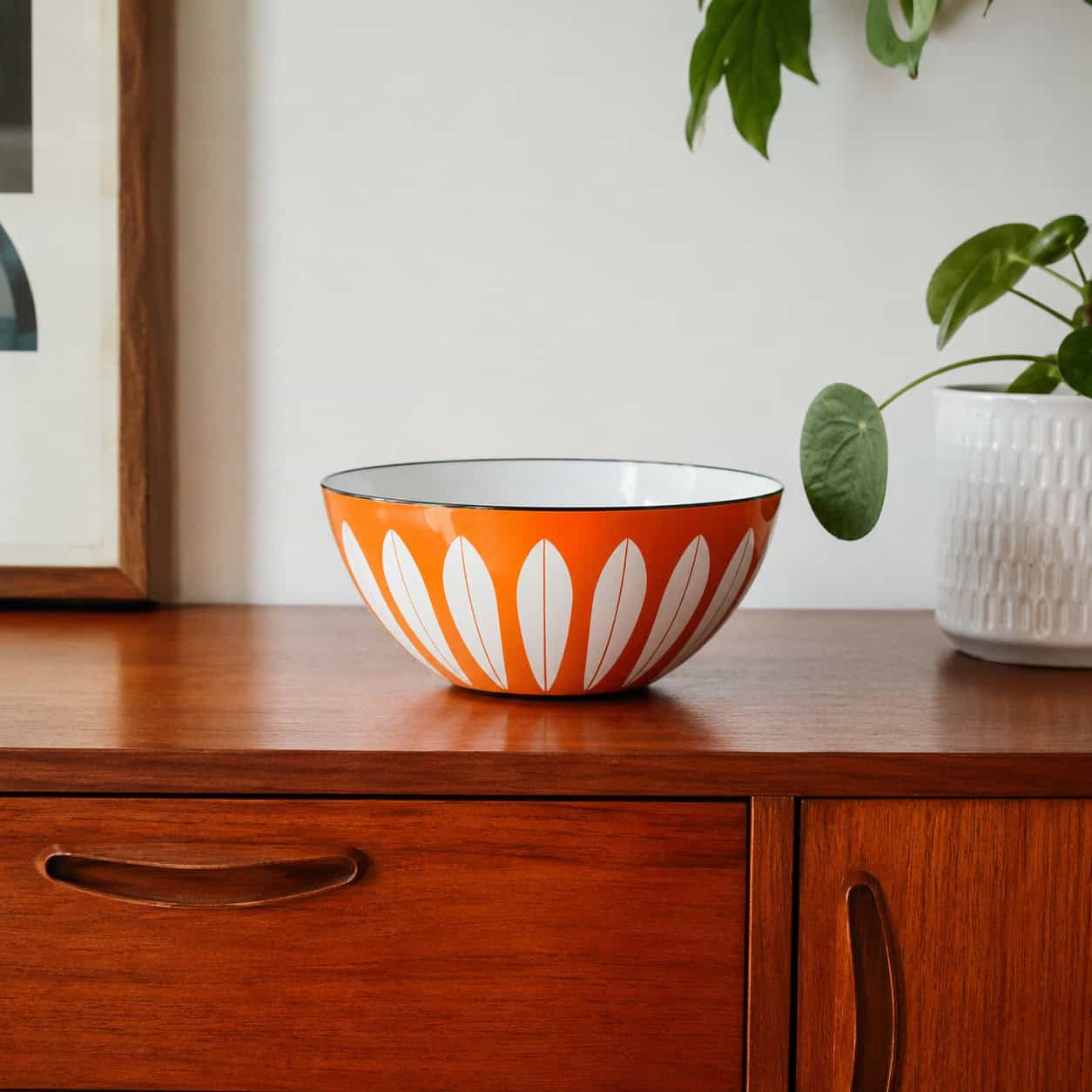
The upscale mid-century-modern one. Scandinavian, graphic, and instantly Instagram-famous.
Norway’s Cathrineholm produced the Lotus pattern from 1962 to 1965 — bold enamel bowls with a stylized petal design that looks straight out of a design museum.
Color drives the price. The rare pink Lotus bowl has sold for $522, and other scarce colorways command strong money among mid-century-modern buyers.
Enamel chips are the enemy. Buyers want clean rims and an unbroken pattern, since the graphic design is the entire appeal.
If grandma had a Scandinavian streak in her cabinets, this is the piece worth pulling to the front.
25. Vintage Nesting Mixing Bowl Sets (unfaded paint)
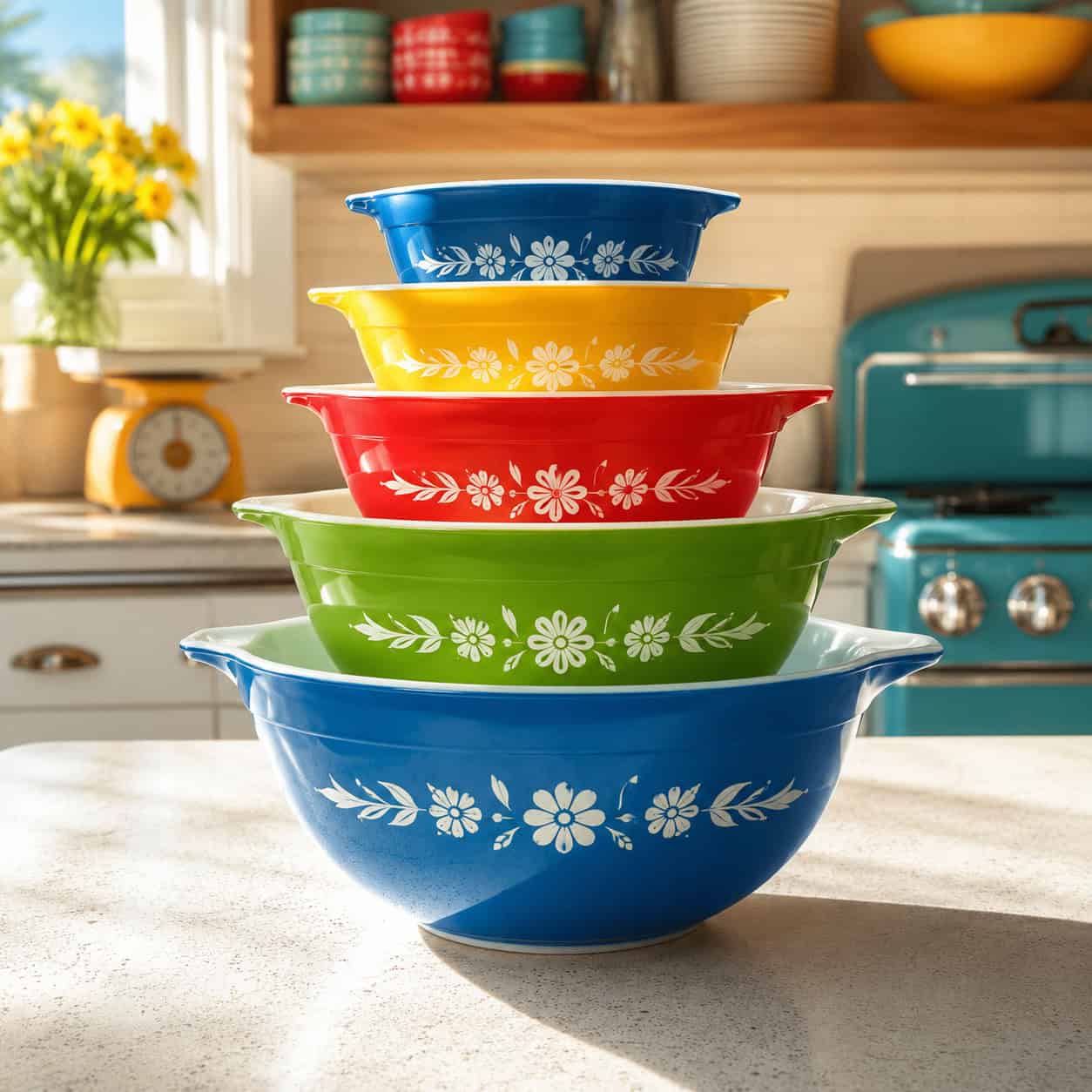
Save the simplest one for last, because it hides in plain sight.
Colorful nesting mixing bowls from the 1950s and ’60s — the graduated sets in cheerful primary colors — can be surprisingly valuable when the paint is pristine.
Unfaded paint is the whole story. Decades of dishwashing dulls and scratches the color, and a faded set is worth a fraction of a mint one. Bright, even, un-scratched paint drives the big sales.
Complete graduated sets, all sizes present, bring the most. A single orphan bowl is worth little.
Check inside and out for wear where a spoon or a sponge rode against the finish. If the color still pops on every bowl, you’re looking at the top of the market.
The Real Takeaway
None of this was meant to be treasure. It was flour bags and Dish Nights, door-to-door salesmen and wedding gifts, the everyday stuff of an ordinary kitchen.
That’s exactly why so much of it got used up, faded, chipped, and thrown out — which is what makes the survivors worth real money now.
Before you clear out an estate, slow down. Flip things over. Read the marks, hold the colors to the light, keep the lids with the dishes.
Grandma’s clutter might be the most valuable thing in the house.
Love this…some items we had as kids in the 40s-50s.